
House of The People: An Experiment in Direct Democracy
'House of The People' lets voters judge the same bills Parliament votes on in real-time, then compares public results with MPs, Lords, parties, while cataloging laws and statutory instrument. It makes democratic distance visible, bill by bill.

House of The People ("HoTP") is a new civic platform built around a simple, rather dangerous idea for Westminster. What would we discover if we allowed the public vote on the same bills Parliament votes on? How might public outcomes, in a direct democracy format, compare to the outcomes reached by their parliamentarians?
That is the question which this project sets out to answer, and has done so admirably.
In contrast to the Westminster convention of moving at the pace of wet concrete, HoTP has elected to move fast and break the fiction of representative democracy outright.
Its homepage states:
“Vote on every bill. Track every MP. See if Parliament actually represents you.”
A live counterweight to the House of Commons of its sophistication has not been attempted. It boasts 178,681 votes cast by members of the public as of 4 May 2026.
The site's choice of emblem is telling, and, if you will forgive the aside, rather neatly illustrates House of the People’s function.
The portcullis was the badge of John Beaufort, Marquess of Dorset and Somerset (c.1371-1410), bastard son of John of Gaunt, Duke of Lancaster (1340-1399). The Beaufort portcullis is a heraldic symbol depicting a closed gate – it is strongly associated with parliament today – but was initially adopted by the royal household by way of Lady Margeret Beaufort – mother of Henry VII. It has been a symbol associated with the English parliament since the time of Henry VII (and, used prominently in carvings within the now-lost Richmond Palace) and more prolifically in Henry VIII’s reign, after the 1534 settlement with Rome. The closed gate, now adorned with a crown (the original Beaufort symbol was not), appears on the penny coin, and on the back of every chair in the Houses of Commons and Lords. Since 1967, the crowned portcullis has been used exclusively on House of Commons stationery.



Left, The Beaufort Portcullis. Centre, The Tudor iteration of the Portcullis. Right: Lady Margaret Beaufort, Portrait, 16th century (Artist Unknown).

House of the People chooses an un-crowned portcullis gate, it also depicts that gate open. This is a project committed to a reversal of the gatekeeping which has held Britain back.

In their own words:
The site’s own About page calls it “The People’s Parallel Parliament”. It says representational democracy may remain, but must be made to serve the people it claims to represent. At the time of review, the site states that it tracks more than 3,800 bills across 20 parliamentary sessions. The ambition is to let citizens vote on the legislation going through Parliament, then show whether MPs are voting with or against the people who sent them there. (House of The People)
The mission document is more philosophical than the website itself, and useful for understanding the project’s tone. House of The People starts from the view that British politics is not mainly a morality play about wicked politicians and noble voters. It argues that bad outcomes are produced by systems, incentives and institutional design. Safe seats, first-past-the-post, party whipping, lobbying and donor influence all shape behaviour before any individual MP gets to play the hero or villain. The mission’s neatest line is this: “If people are products of their system, let’s build a better system.”
That is what distinguishes the project from the usual online politics fare. It is not another petition site where people shout into the administrative void and receive a PDF in return. Nor is it a party, campaign group or ideological front. Its claim is narrower and stronger. It wants to create a continuous public vote on the work of Parliament, producing hard comparative data between what the public supports and what Parliament actually does. The mission describes this as a real-time feedback loop between the population and policymakers.
Votes on Bills:
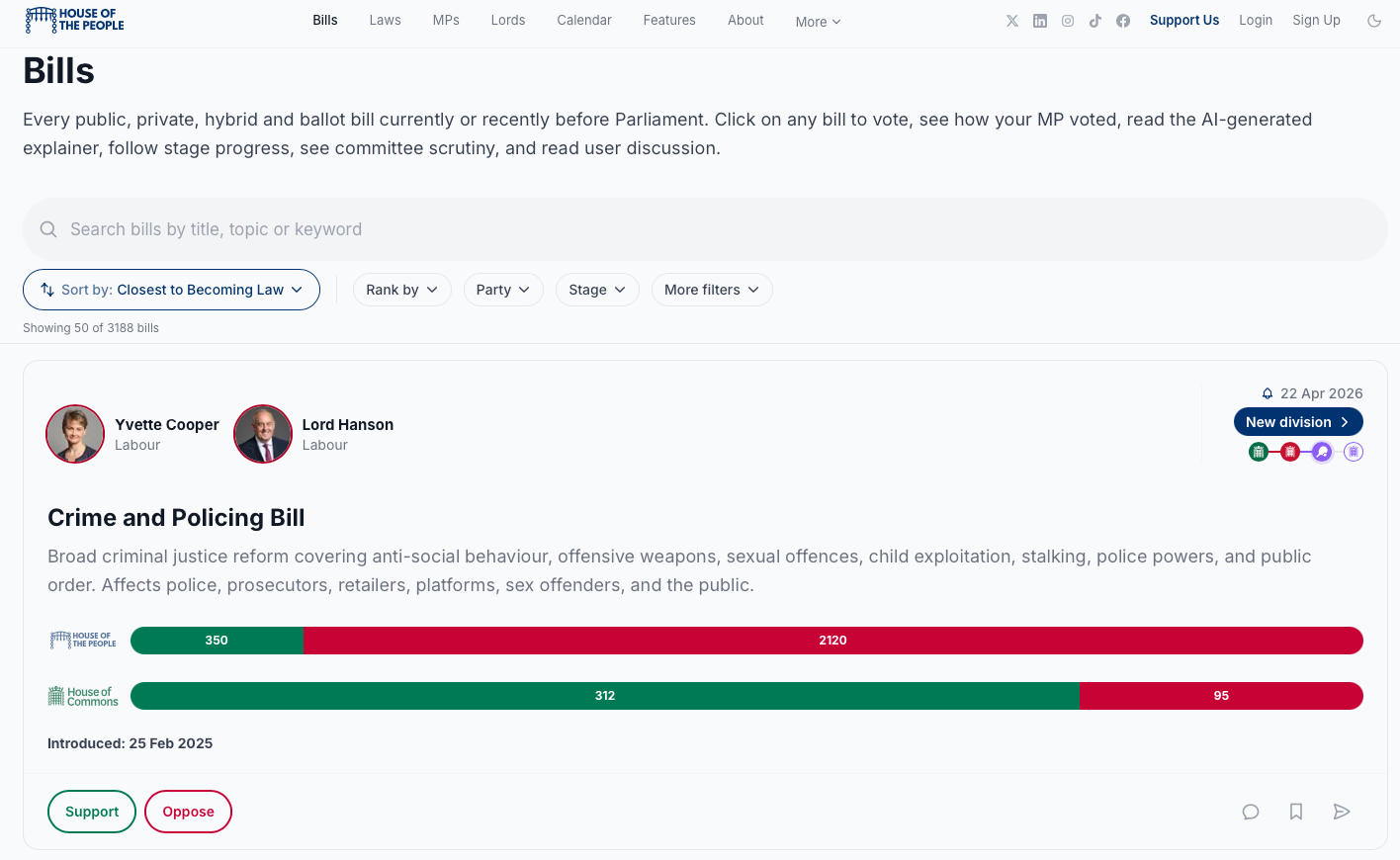
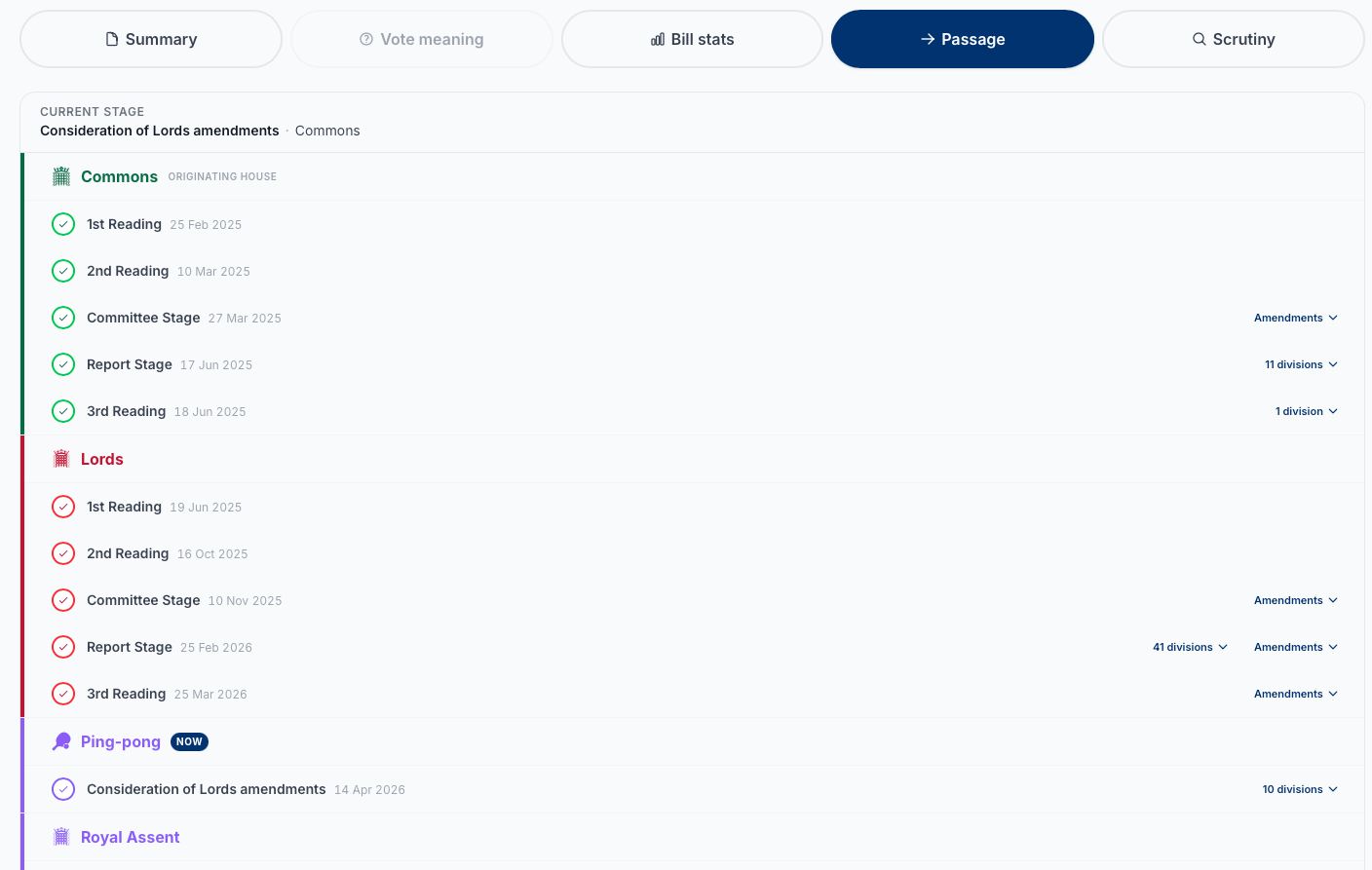
The Bills section is the core of the project. It is where users are meant to browse, rank and vote on UK parliamentary bills. The Features page describes the basic function as the ability to “support or oppose every bill since 2006”. In practice, this turns legislation from something most people encounter only after it has passed into something they can follow while it is politically alive.
Enacted Laws:
The Laws section complements the voting on live bills; this section looks backwards, rather than forwards. Bills are the proposals, whereas laws are the finished products. HOTP allows users to express a view on laws which have already passed, essentially letting the public see what Parliament has recently enacted, and, pass judgment on it.
As the section states:
"Click on any law to see its full text, the divisions held during its passage, how each MP voted, and the committee scrutiny it went through".
For anyone trying to understand how the statute book got where it is, that is rather more useful than listening to ministers insist everything is under control.
Tracking the Gap:
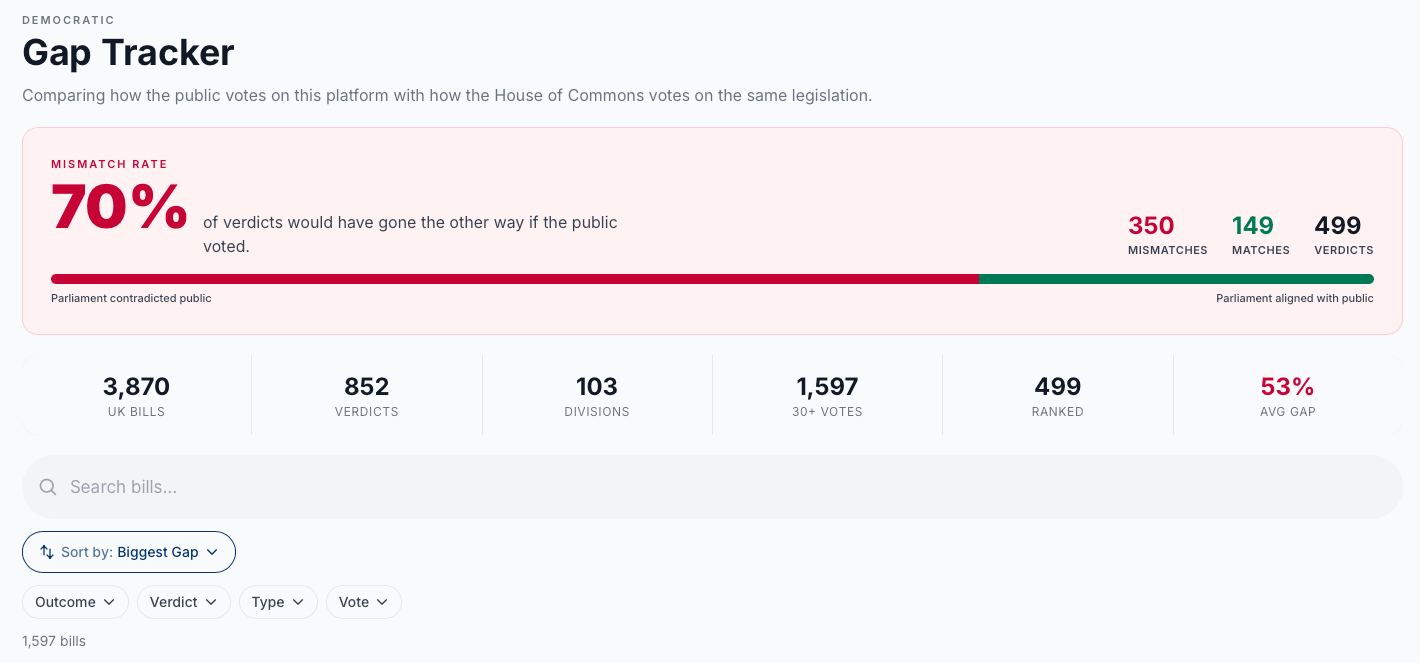
The Gap Tracker is the conceptual centre of the site. It compares how the public votes on House of The People with how the House of Commons votes on the same legislation. The About page gives the obvious example: if 80 per cent of users oppose a bill and Parliament passes it anyway, the site treats that as evidence of a democratic deficit.
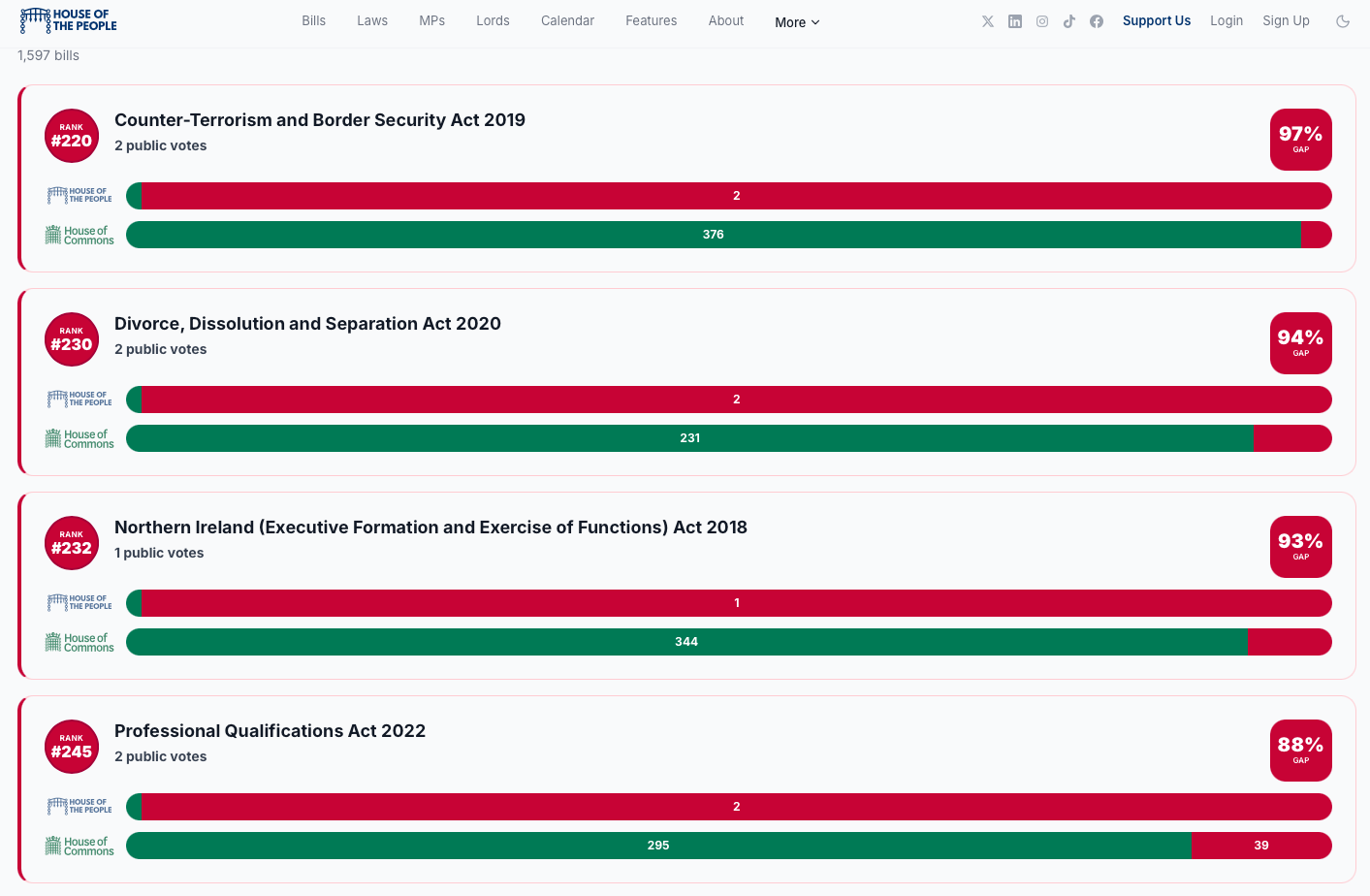
That does not prove Parliament is illegitimate, and it does not mean the site’s users are automatically representative of the whole country. It does, however, create a measurable point of conflict. Instead of the usual vague complaint that politicians are “out of touch”, it provides a bill-by-bill record of where the public vote and parliamentary vote diverge.
Compare with Your MP:
The MPs section is designed to let users examine Members of Parliament and their voting records. The Rank MPs by Your Votes page takes that further by promising personal alignment rankings, showing which MPs most closely match the user’s own voting pattern.
Public alignment with parties:
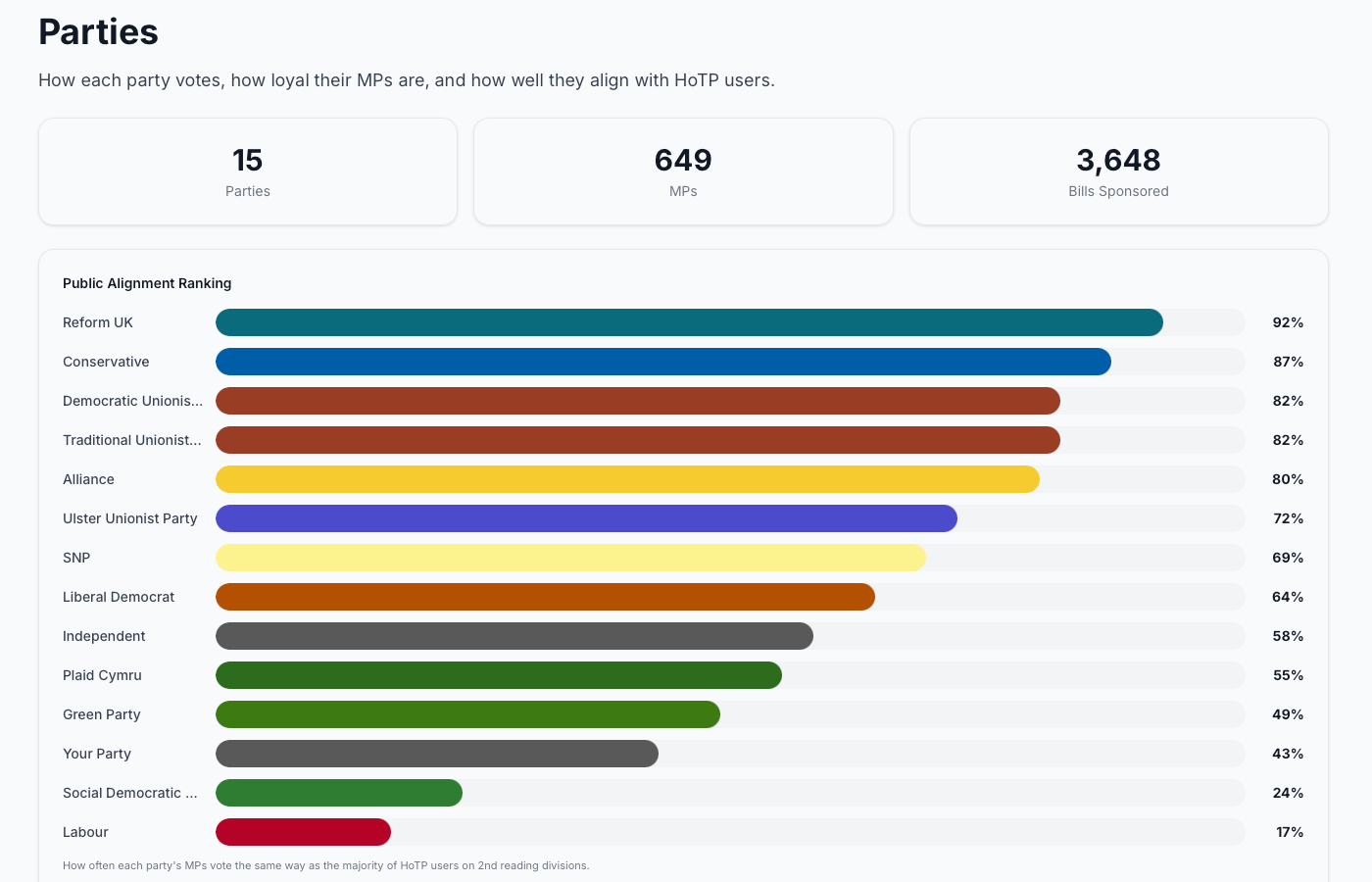
The Parties section applies the same scrutiny at party level. Its page describes:
How each party votes, how loyal their MPs are, and how well they align with HoTP users.
That means users are not limited to judging individual MPs. They can also see how parties behave as blocs, how closely they align with public voting on the platform.
As of 4 May 2026, HoTP users most closely align with the voting activity of Reform UK, followed closely by the Conservative Party, DUP and TUV. By comparison, Labour ranks the lowest, at just 17% alignment.
Lords:
The Lords section extends the project into the unelected (or more accurately, appointed) chamber.
The Features page describes it plainly:
Every member of the House of Lords. Sort alphabetically or rank by activity, party loyalty, or bills sponsored. Click on any Lord for their voting record, sponsored bills, committee memberships, registered interests, career timeline and recent parliamentary activity.
A searchable record of who sits there and how they vote is the minimum courtesy owed to the people who are governed by its revisions, delays, and seldom-reported acts of good sense.
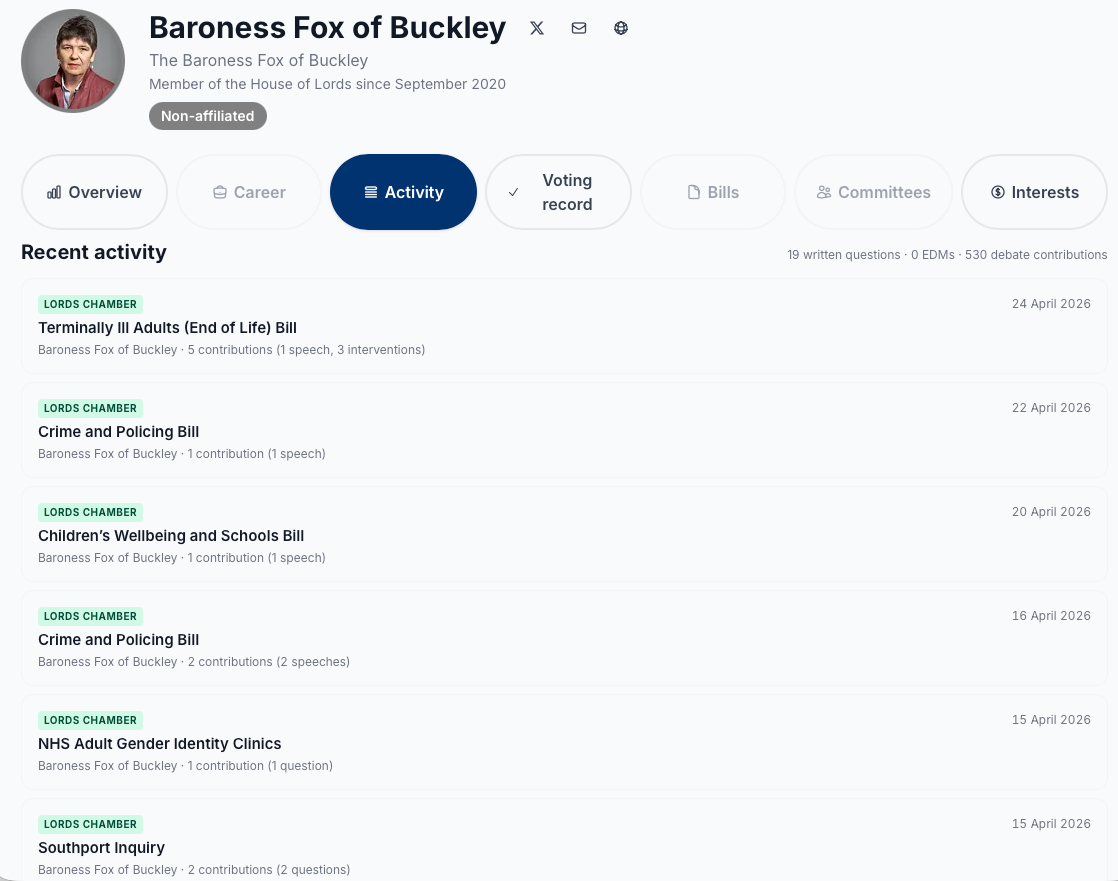
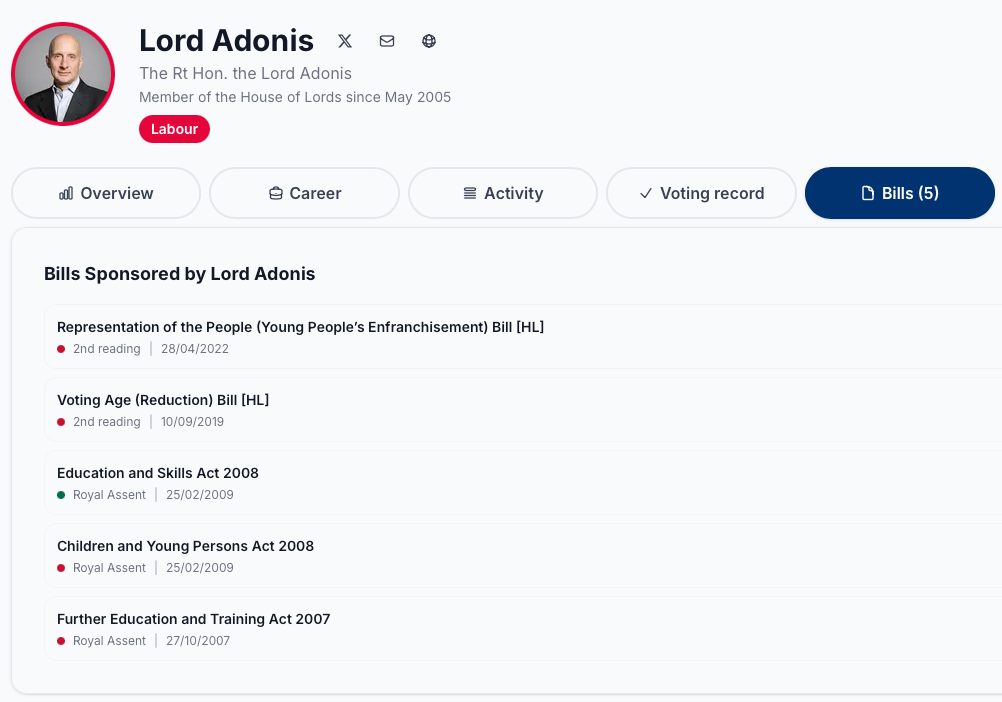
Members of the House of Lords can be explored along a variety of lines. Right, we see the bills proposed by Lord Adonis: https://houseofthepeople.com/lords/3743 Left, we see the upper house activity of Baroness Fox of Buckley: https://houseofthepeople.com/lords/4887
Committees:
The Committees section is more procedural, but important. The site describes parliamentary committees as cross-party groups of MPs and Lords which scrutinise government policy, legislation and spending, produce reports, hold inquiries and question ministers. This is precisely the sort of thing serious political journalism should live on.
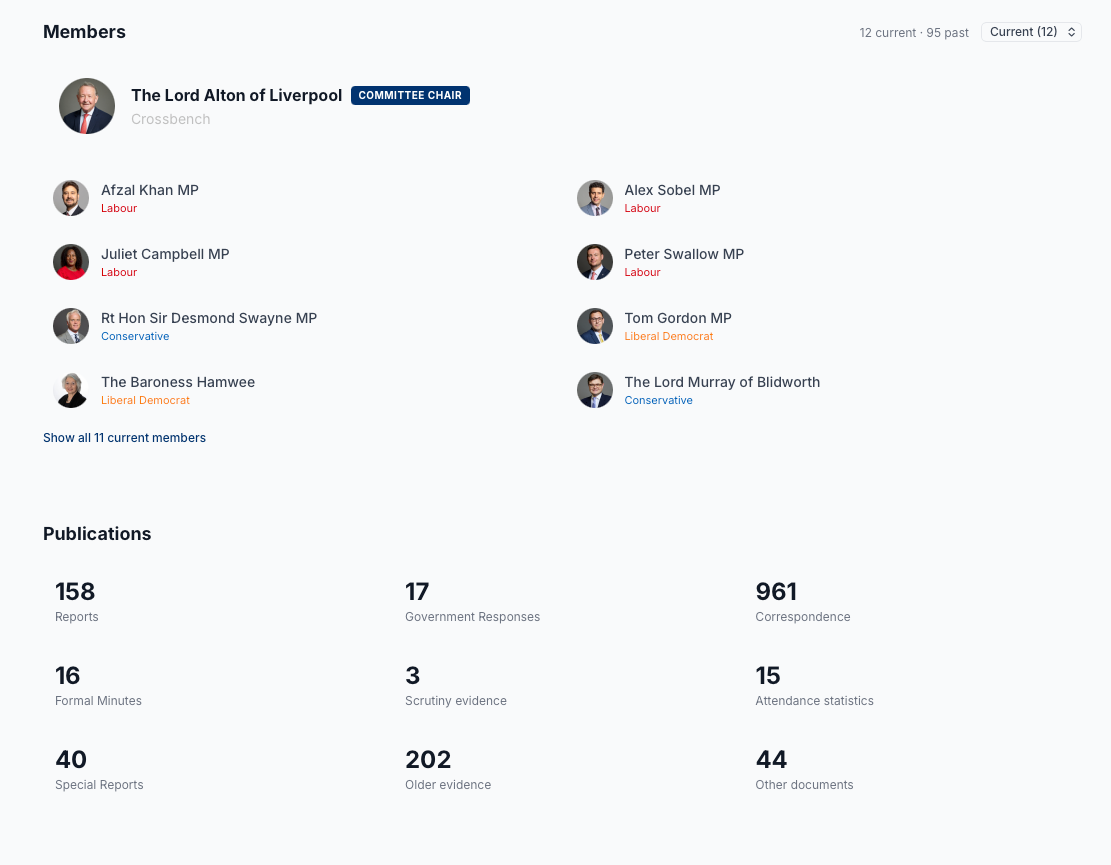
By way of example, here we can see the Human Rights Joint Committee, chaired by by Lord Alton of Liverpool. We also see its full activity, and contact details (listed at the bottom): https://houseofthepeople.com/committees/93
Committees are where a great deal of actual scrutiny happens, and placing them inside the same public-facing system gives users a way to follow not only the vote, but the machinery around the vote.
The Statutory Instruments Section:
The Statutory Instruments section may be the most constitutionally interesting part of the site. It explains that most UK rules do not get their own full parliamentary vote – known as secondary legislation.
Once Parliament passes an Act, ministers can use powers under that Act to make detailed regulations by statutory instrument. The page says:
Around 3,000 are made each year, covering matters from speed limits to benefit rates.
Secondary legislation is different to ordinary (primary) parliamentary legislation. Parliament passes an Act which gives ministers power to fill in the detail later. Those later rules are usually made as statutory instruments ("SI's") – which this section tracks. They are law, but they are not normally debated and amended line-by-line like a Bill. 7,316 SI's are displayed on HoTP's site.
The procedure attached to the instrument tells you how Parliament controls that ministerial law-making power. There are three kinds of SI procedure:
Affirmative means the minister can only use the power if Parliament actively approves the instrument. In simple terms, Parliament must say yes.
Made affirmative means the Government makes the law first, usually claiming urgency, and Parliament votes later. If Parliament does not approve it within the required period, it stops having effect.
Negative means the instrument becomes law automatically unless Parliament objects. This is the most common form. It relies on MPs or peers noticing the instrument, securing time, and successfully forcing an annulment.
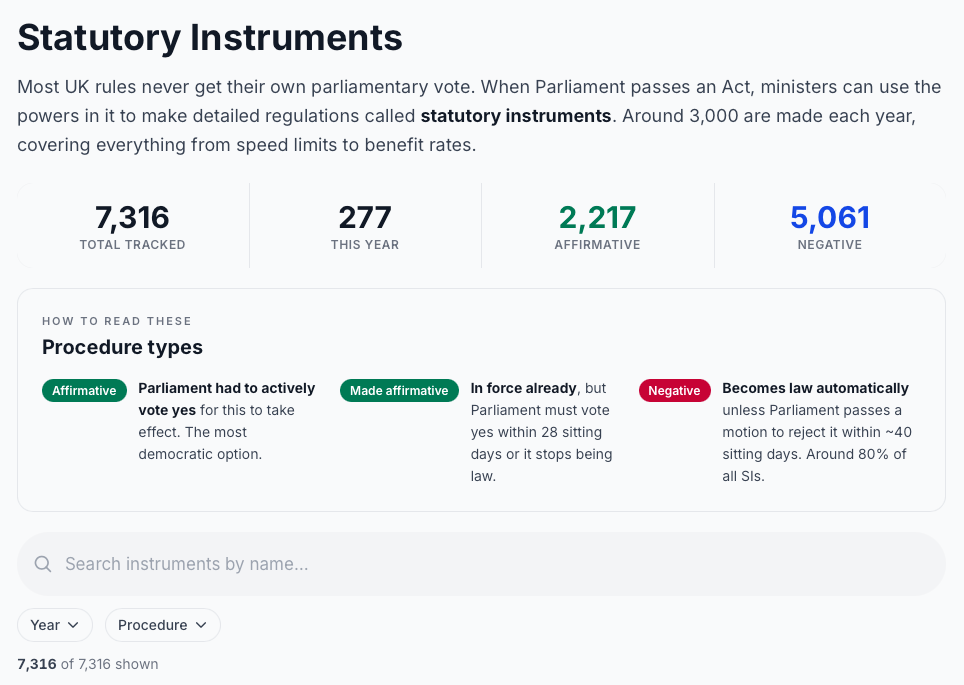
The constitutional point is that secondary legislation lets ministers make binding rules under powers already granted by Parliament. The more the system relies on negative procedure, the more law is made by default rather than by active democratic consent. 4,421 of 7,316 SIs shown by HoTP have been made negative.
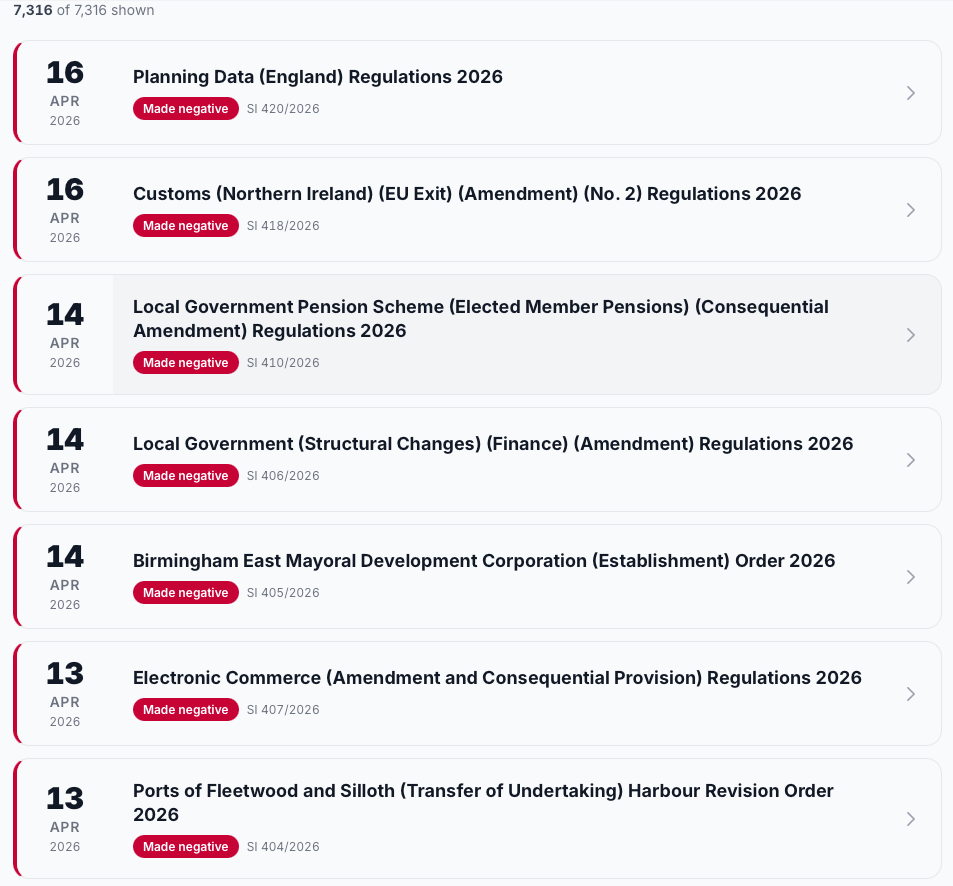
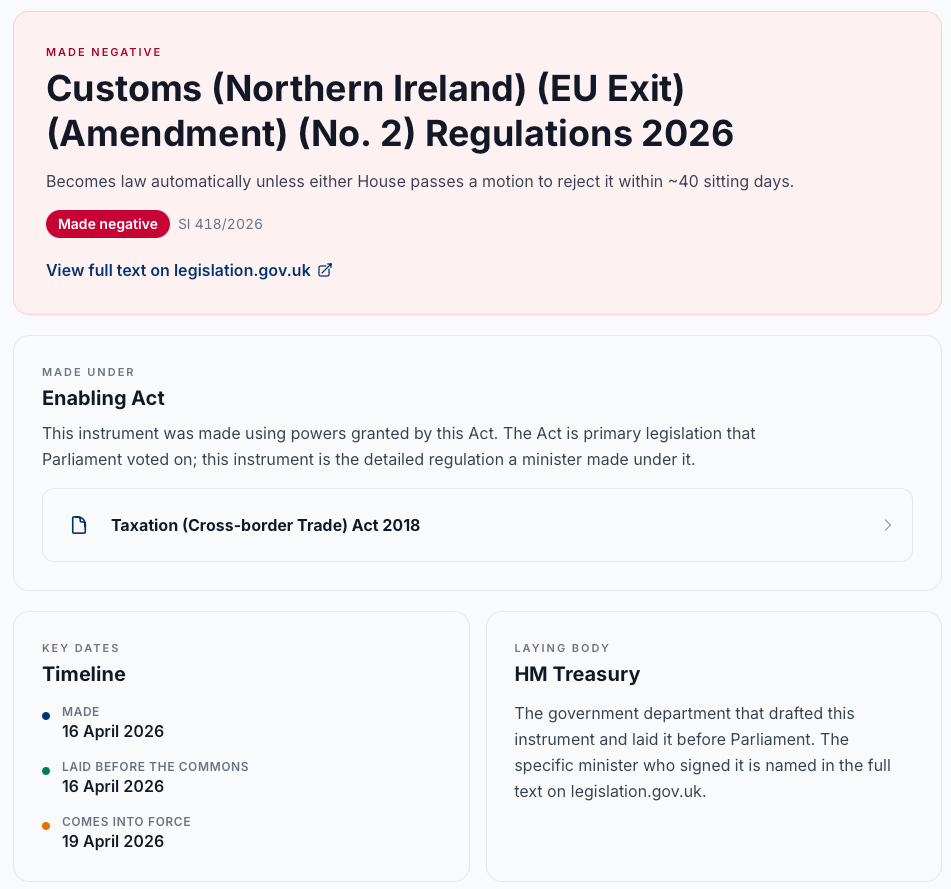
Each SI can be viewed in the context of its enabling act, timeline, and laying body. On the right, we can see an SI (made negative), laid by HM treasury: https://houseofthepeople.com/statutory-instruments/CPEaARI1
Parliamentary Petitions:
The Petitions page is slightly more specialised than the casual reader might expect.
The page describes formal petitions submitted by the public and affected parties against Private Bills and Hybrid bills, meaning legislation promoted by individuals, companies or local authorities rather than by government.
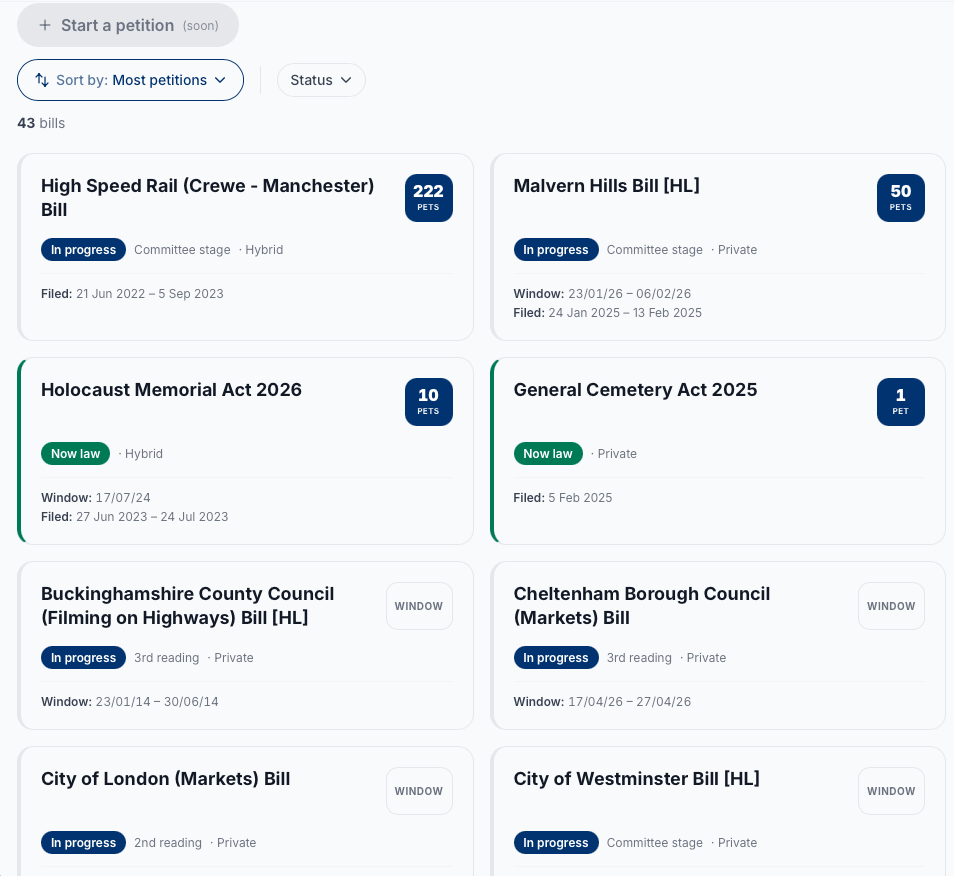
The About page also describes a broader polls-and-petitions function, saying anyone can start one and that signatures are verified against a UK postcode, with 10,000 signatures prompting a government response and 100,000 leading to consideration for Commons debate. That distinction is worth preserving when writing about it: the site appears to be joining formal parliamentary petitioning, public pressure and platform-native civic polling into one public-facing layer.
General (internal) opinion polls:
The Polls section is where users can vote and compare opinion beyond formal bill votes. The page includes a “Submit a Poll” function and sorting by popularity. That turns the site from a legislative tracker into a broader civic sounding board. The risk with any polling function is that it becomes a megaphone for the already-engaged. The value is that, if it grows, it becomes a searchable record of issue-by-issue public sentiment rather than a quarterly burst of Westminster-approved polling questions.

In summary:
For journalists, assuming any can be lured away from refreshing X long enough to go about the business of journalism, the uses of this tool are plain. House of The People lets them compare a public vote with a parliamentary vote on the same bill. It lets them ask whether an MP’s voting record aligns with their constituents’ expressed preferences on the platform. It lets them monitor which parties are most consistently distant from their own voters. It lets them follow secondary legislation, committees and petitions without pretending that politics consists entirely of lobby briefings and ministerial haircuts.
The site should not be oversold. It is not a referendum machine. Its votes are, naturally, non-binding and its users will not automatically form a perfect demographic mirror of the United Kingdom. We are not quite at the point of Swiss-style plebicitical democracy, through referenda, yet. However, these are by no means reasons to dismiss the project. House of The People is trying to make democratic distance visible – in a political system that is as good at hiding behind procedure as Britain's – that is no small feat.
The people will not need to be guessed at, invoked, patronised or theatrically consulted every five years. As this site grows, and so does its voter-base, they will have left a record of their wants and desires.
As Reiners.org.uk has suggested before (here):
What the Englishman wants, if you ask him, is less of the same. He pines for the freedom to breathe, to save what he earns, to speak freely and to enjoy his country among peers with which he shares various things in common with.
House of the People, bravely, asks him.