
Rupert Lowe loses ICGS challenge: High Court keeps Commons disciplinary scheme within parliamentary privilege
The Administrative Court held that Mr Lowe could not use judicial review to challenge the ICGS decision to investigate him. The judgment does not determine the truth of the underlying complaint, which remains live.


The judgment
Rupert Lowe MP has failed in his High Court challenge to the Independent Complaints and Grievance Scheme, usually shortened to ICGS. The Administrative Court did not decide whether the complaint against him was true. It held, at the threshold, that the claim was barred by Parliamentary privilege and could not be pursued by judicial review.
The judgment page records the case as AC-2025-LON-003806, in the Administrative Court, before Mr Justice Chamberlain. The judgment is dated 14 May 2026. The approved judgment records that it was handed down remotely at 10am on 15 May 2026.
The words used by the court were “barred by Parliamentary privilege” and “not justiciable”. In practical terms, the court held that this part of the House of Commons’ disciplinary system is for Parliament’s own machinery rather than the Administrative Court.
The result is narrower than much of the surrounding argument. The judgment does not approve the ICGS investigation on its facts. It does not find that the complaint is well founded, nor does it decide that the ICGS acted fairly in every respect. It says that the High Court cannot enter into those questions in this claim.
How this case reached court
The ICGS is Parliament’s complaints scheme for bullying, harassment and sexual misconduct within the parliamentary community. Parliament describes it as available to people who have experienced, witnessed, or become aware of such conduct.
The approved judgment records that a complaint about Mr Lowe was made to the ICGS on 28 January 2025, with further allegations made on 28 April 2025. On 23 July 2025, the ICGS informed Mr Lowe that an allegation would proceed to investigation. The following day he received an initial assessment report dated 30 June 2025. That report made clear that only one allegation was to be investigated.
Mr Lowe filed his judicial review claim on 23 October 2025. He later sought interim relief to stop the investigation pending determination of the claim, or until permission to apply for judicial review was refused. That application was refused on 24 February 2026. The issue returned for the preliminary hearing on 17 March 2026, which was the subject of the previous report.
Mr Lowe’s grounds were serious, but at this stage they remained allegations. He said the decision to investigate was unreasonable, that the complaint was vexatious and part of a campaign of harassment against him, and that the ICGS decision was affected by apparent bias in favour of MIC and against him. The court did not decide whether any of those criticisms was made out.
Why the Speaker defended the claim
The ICGS was the named defendant, although the judgment records that the ICGS is not itself a legal entity. The claim was defended by the Speaker of the House of Commons.
The Speaker’s position was that the activities of the ICGS fall within the exclusive cognisance of the House of Commons. On that view, the court was precluded by Parliamentary privilege from entertaining the claim. The case was therefore about more than the fairness of one investigation. It required the court to draw the constitutional boundary between the courts and the House of Commons.
Parliamentary privilege and problem 'quango-like' parliamentary bodies present
Parliamentary privilege is not a personal perk for MPs. Its orthodox justification is that Parliament must be able to do its work without outside interference, especially from the courts or the executive. Article IX of the Bill of Rights protects proceedings in Parliament from being impeached or questioned in any court or place out of Parliament. Exclusive cognisance is the wider common-law principle by which each House controls its own internal affairs.
The ICGS case sits awkwardly between those ideas. It was not a case about a speech in the chamber or a vote in the division lobby but rather is concerned with the complaint-handling process which Parliament itself has advertised as independent. That complaint-handling process, as it is constituted today, can operate through investigators and decision-makers who are not MPs. The Independent Expert Panel is described by Parliament as entirely independent, with no MPs taking part in its decisions.
Strictly, the ICGS is not a quango in the ordinary legal sense. The judgment records that it is not a legal entity. Even so, the public concern is quango-like. Here is an independent administrative machine, staffed outside the ordinary ranks of elected Members, exercising disciplinary power in a public institution and then protected, on the High Court’s view, by the privilege of the House itself.
The public criticism bites at this point. Independence was introduced because MPs judging MPs had become intolerable. If the independent machinery is then insulated from judicial review because it remains parliamentary, it may look like a body which is independent enough to avoid direct political responsibility, yet parliamentary enough to avoid ordinary legal scrutiny. A reader need not accept Mr Lowe’s case to see why the arrangement invites unease.
Why the court accepted the Speaker’s objection
Mr Justice Chamberlain did not accept that independence from MPs meant independence from Parliament. He treated ICGS investigations into MPs as disciplinary, not merely administrative. The classification placed the case in an area historically regarded as belonging to the House.
The court also attached weight to the framework created by the Commons. The ICGS, the Parliamentary Commissioner for Standards and the Independent Expert Panel were treated as parts of the same disciplinary architecture. The Panel’s independence did not make it external to Parliament; in the court’s analysis it showed that Parliament had provided its own internal route for discipline, appeal and sanction.
The possible sanctions were not minor. The judgment referred to withdrawal of services and facilities, dismissal from a select committee, suspension, loss of salary and expulsion from the House. Some sanctions require confirmation by the House itself. If a court could stop the investigation at the beginning, the judge reasoned, it could prevent the House from ever reaching a disciplinary outcome.
The political setting also influenced the constitutional analysis. Mr Lowe said the complaint was politically motivated and made in bad faith. Mr Justice Chamberlain expressly stated that he had reached no conclusion on that assertion. His point was different. If the court entertained the claim, it would have to decide whether a complaint to Parliament’s own disciplinary scheme had been brought for political reasons. The judge considered that Parliament had sound reasons to reserve such determinations to its own internal framework.
The conclusion appears in paragraph 68 of the approved judgment. The whole disciplinary framework, including the parts entrusted to the ICGS, the Commissioner and the IEP, falls within the exclusive cognisance of the House of Commons.
Jacob Rees-Mogg’s interventions
Jacob Rees-Mogg occupies an awkward place in this history. In June 2020, as Leader of the House, he was named in the Government announcement that MPs would be asked to transfer sanctions powers in ICGS cases to an independent panel. He called it an “historic moment for Parliament”.
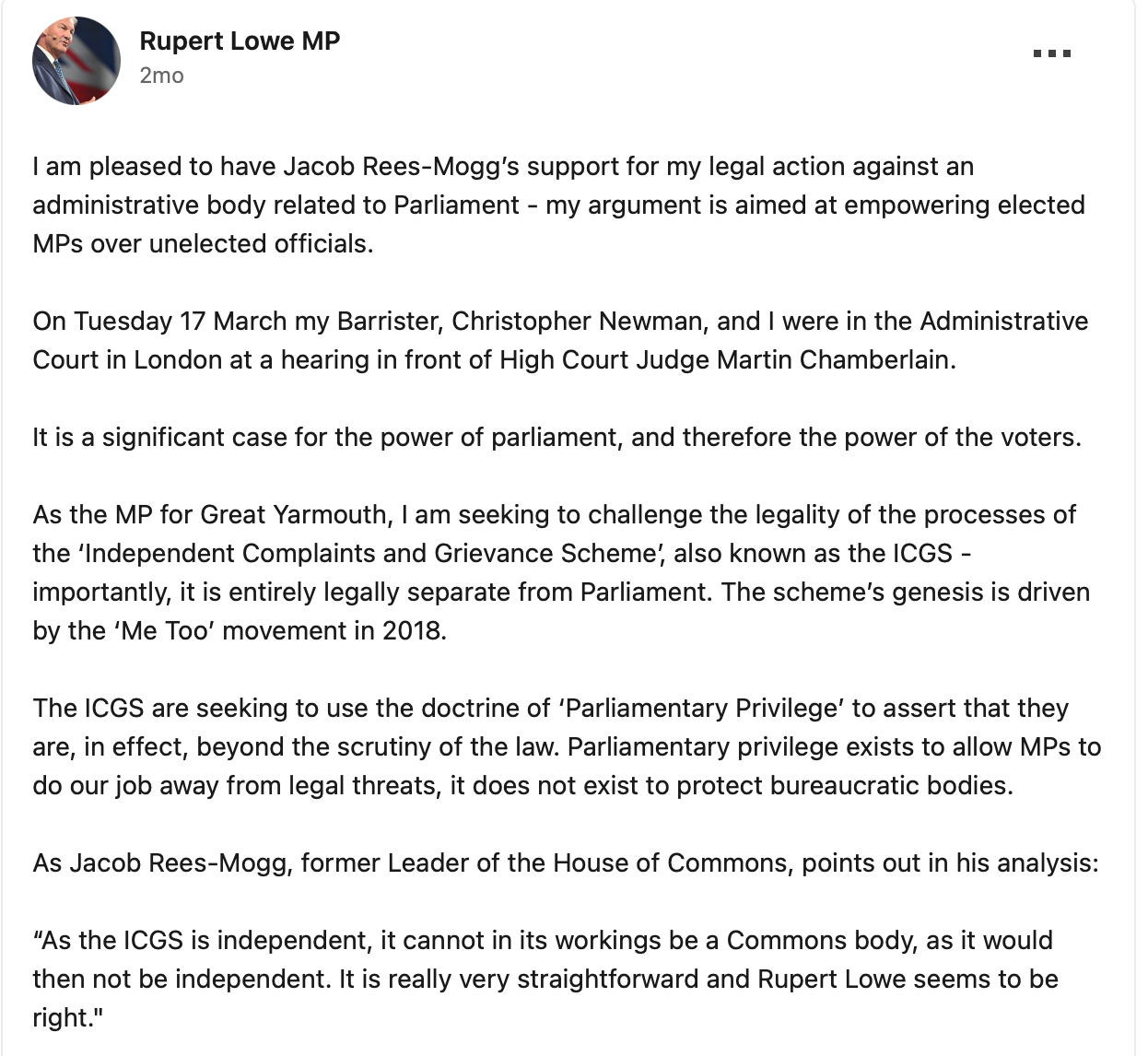
By March 2026, however, Rees-Mogg was writing in support of the constitutional argument Mr Lowe advanced. In his article Rupert Lowe and Parliamentary Privilege, he described Parliamentary privilege as a “great protector, a cornerstone of the Constitution”, while warning that it must be narrowly defined because a wide version could lead to abuse.
Mr Lowe’s own public post before judgment quoted Rees-Mogg as saying, “As the ICGS is independent, it cannot in its workings be a Commons body”. Lowe also quoted Rees-Mogg’s complaint that responsibility had been handed to “unelected boffins”. The post placed those comments at the centre of the argument against the ICGS relying on privilege.
The High Court disagreed with that legal conclusion. It held that the ICGS, the Commissioner and the IEP remained within the House’s internal disciplinary framework. Rees-Mogg’s criticism still captures the public objection. Parliament created a scheme which it tells the public is independent, then told the court that the same scheme is internal enough to be protected from judicial review.
What the judgment does not decide
Several propositions should not be smuggled into the judgment. It does not say that Mr Lowe bullied or harassed anyone. It does not say that the complaint against him is true. It does not say that the ICGS was correct to proceed. It does not decide that Mr Lowe’s allegations of bad faith, political motivation or apparent bias were wrong.
The court decided jurisdiction. Mr Lowe lost because the High Court held that it could not hear his judicial review claim. He did not lose on the merits of the underlying complaint.
The judgment also does not make every matter connected with Parliament immune from ordinary law. The authorities discussed by the court, including R v Chaytor, preserve a distinction between Parliament’s protected internal affairs and other matters such as criminal law, contract, tort and ordinary administrative implementation. The line drawn in this case concerns the discipline of MPs under the House’s own ICGS framework.
Mr Lowe’s reaction
Mr Lowe’s reaction was political and forceful. In a public statement after the ruling, he said his aim in court had been to reclaim power for elected MPs and the people from unelected bureaucrats, and he summarised the result with the words, “I failed”. GB News also reported his criticism that unelected civil servants could weaponise parliamentary privilege.
That was Mr Lowe’s framing, not the court’s reasoning. The judgment did not hold that ICGS staff possess a personal immunity superior to that of MPs. It held that the House had created a disciplinary framework for MPs, and that the framework remains constitutionally internal to the House.
The legal question has been answered against Mr Lowe at High Court level. The political question remains. Should a complaints scheme introduced to remove MPs from judging other MPs also be open to judicial review, or should it remain within Parliament because it concerns the discipline of Members of Parliament?
Testing the principle by an extreme case
Because this is only a High Court decision, it should not be treated as the last possible word on parliamentary privilege. Its logic can still be tested by a deliberately extreme example. Assume a compliant House of Commons majority. Assume also that a Prime Minister, Keir Starmer for example, wished to turn a political discipline role (such as one at the ICGS) into a permanent institutional office for himself.
On the critical view of this judgment, he would not need to announce himself as ruler. He could ask the House to create an eternal chairmanship, or a permanent governorship, over a body concerned with the discipline of MPs and the policing of parliamentary conduct. If that body’s work were then characterised as part of the House’s internal disciplinary framework, the ordinary court route might be closed. The safeguard would be whatever Parliament itself was prepared to provide.
Critics would add that Parliament has a poor habit of creating bodies in response to crisis and then allowing them to acquire their own institutional defenders. In the deliberately theatrical version of the example, the Prime Minister appears to reign forever by process rather than proclamation. The example is overdrawn, and it is not an allegation about Sir Keir Starmer. It is a stress test of the claim that a quango-like disciplinary body can be simultaneously independent from MPs and protected by the Commons’ own privilege.
The judgment answers the problem by saying that Parliament may delegate disciplinary functions within its own constitutional space without surrendering them to the courts. Critics say this leaves too much power in an administrative machine which ordinary voters, and MPs alike, cannot easily remove – a machine which judges cannot easily provide supervision for.
Why this decision goes beyond Mr Lowe
The ruling clarifies the legal position of Parliament’s post-2020 complaints machinery. For ICGS disciplinary investigations into MPs, the Administrative Court will not supervise the process by judicial review. Allegations of unfairness, apparent bias, bad faith or political motivation must be dealt with inside the parliamentary framework.
The argument for the ruling is one of constitutional restraint. Courts should not police Parliament’s internal discipline. The House is a legislative body, and its membership, committees, sanctions and internal standards affect how it functions. Judicial intervention may trespass into a constitutional area which belongs to Parliament.
The argument against the ruling is one of administrative accountability. Judicial review is often the safeguard sought when a public process may be unfair. Mr Lowe’s argument was, in effect, that without court scrutiny a respondent MP may be left without any variety of external remedy. That argument failed in law in the high court, but it remains the strongest public-policy objection to the result.
The difficulty is not resolved by the word “independent”. The ICGS can be independent in its day-to-day handling of complaints, and still internal for constitutional purposes. The High Court has now allowed those two propositions to sit together.
Conclusion
Mr Lowe failed on jurisdiction in this instance. The court did not find the complaint against him well founded, and it did not approve the ICGS process on its facts. It held that the ICGS, the Parliamentary Commissioner for Standards and the Independent Expert Panel form part of a disciplinary framework falling within the exclusive cognisance of the House of Commons.
The practical consequence is that the ICGS investigation is not stopped or quashed by this judicial review claim. The constitutional consequence is more difficult. Parliament has created a system independent of MPs, but not independent of Parliament itself. Unless Parliament alters that settlement, or a higher court does so, the disciplinary scheme remains outside ordinary judicial review for the moment, and knowing the nature of the permanent state, is likely to expand its purpose further.