
Keir Starmer: Prime Ministerial Imposter Syndrome (written July 5th 2024)
Michael Reiners, writing on the eve of the 2024 election, argues that Starmer’s vast majority rests on Conservative collapse and Reform’s insurgency - leaving Britain’s new Prime Minister, most comfortable as a prosecutor, to impersonate authority while constrained by the ECHR settlement.

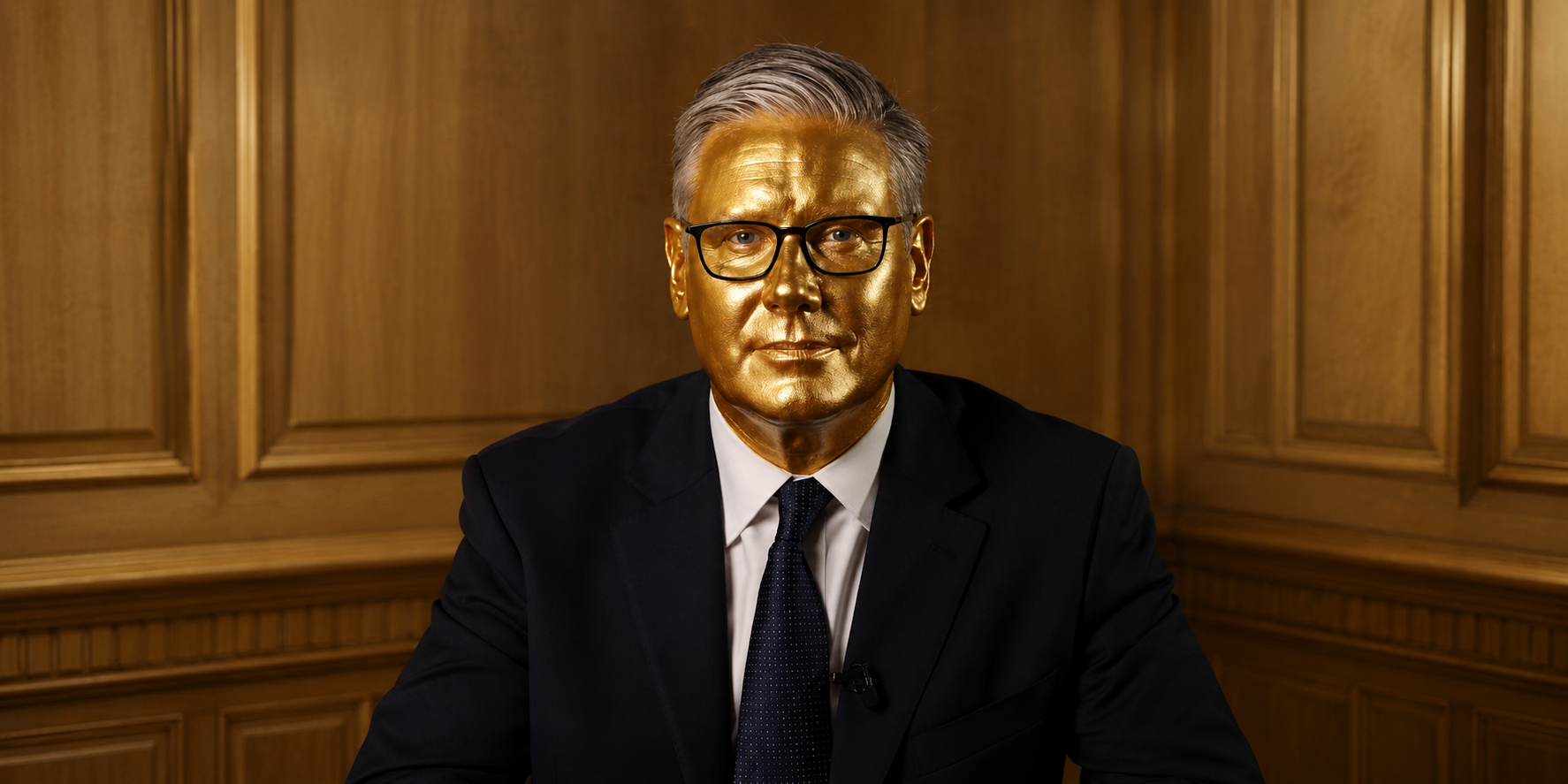
Fortunately, I have spent the last month perfecting my Kier Starmer impression. It comes from the back of the throat, at the roof of the mouth, near the nose – it's gnomish, and has shades of Facejacker’s Brian Badonde too. Ideally, you don’t want to say much when doing a good Starmer. Impersonations are something the incoming Prime Minister is going to have to master too. Namely, pretending to be someone who earned his 411 seat victory on his own merit.
The party with the third largest vote-share, at 4.1 million (Reform UK), has 5 seats. The fourth largest (Liberal Democrats), 3.5 million, has 71 seats. In terms of their share of the vote, Labour had a smaller vote share than it did under my favourite closeted Eurosceptic, Jeremy Corbyn. All a bit odd.
It all seems less odd when you realise the Conservatives’ 2019 majority was entirely made up of borrowed Brexiteer grit and facilitated by Nigel Farage’s party (then, The Brexit Party) standing down in key Conservative seats. This time, no such kindness.
Farage’s rebranded Reform UK tails as the second largest vote in 98 constituencies from Sunderland to Louth & Horncastle. They have slit the Cons' throats in their sleep, and reclaimed the vigour which Boris Johnson momentarily captured in 2019.
My Cambridge-educated labourite peers must be disgusted; they have Farage to thank personally for delivering the first Labour government in 14 years. Yet, a stuffed animal could've secured this majority, given the electoral conditions.
Again, Rishi and co probably should've heeded my warnings in February 2023, forecasting their destruction if they didn't eject the UK from the European Convention on Human Rights (‘ECHR’) for the purposes of slowing net immigration, or departed from the sacred document, as a matter of policy entirely. Failure to do either has seen immigration roar to 685,000 in 2023. Departing from ECHR-ism may just have appeased that oh-so forgotten electoral demographic, the Englishman. Reform entirely stole this platform from the Conservatives for the duration of this election, which cost them dearly.
As wounds are licked it seems likely that the changes in the economic & immigration landscape may continue to go ignored by surviving Conservatives. Instead, the party may choose to replicate the recovery plan they deployed after 1997, namely, shifting leftward. At present, there is a great and gaping void on the right of British politics. Through the actions of Reform UK, failure to observe that void has destroyed the Conservatives.
As Director of Public Prosecutions ("DPP") in 2009, Starmer decriminalised assisted suicide for the terminally ill, essentially giving the green light to "the compassionate partner of someone who does want to die". The Rory Stewarts of the world – dubiously compassionate conservatives – will likely be keen to try this out on their terminally ill party, which appears to be seeking a swift end.
They will doubtless suggest that the Conservative party has lost votes to the Greens, to the Liberal Democrats and Labour. Whoever is left in the Conservative party will insist that “broad church” approach is needed to “reunite the country”. Doing so will be assisted party-political suicide, something Starmer will no doubt support just as enthusiastically as he did back in 2009.
Starmer is an awkard man, and in his political and legal life proved to be most in-his-element on two occasions:
1) When campaigning for a second EU referendum.
2) When prosecuting the London rioters, of 2011, in shotgun-trials as DPP.
One wonders which of these two comfort-blankets will characterise his duration as PM. Prosecutors do not make for compelling leaders, as has been neatly demonstrated by Kamala Harris, who has required desperate PR campaigns to humanise a politically appointed prosecutor. Harris' own background is similar, in timeframe, to Kier's. She was elected district attorney of San Francisco in 2003 and attorney general of California in 2010 – after her term, she entered politics proper. For Starmer, he served as DPP from 2008 to 2013, then, entered parliament in the 2015 general election. His seat, (Holborn and St Pancras) was previously held by the Frank Dobson – the longest-serving Labour MP in London until he stood down in 2015.
On the upside, at least the incoming Prime Minister has been appointed a Knight Commander of the Order of the Bath for “services to law and criminal justice”– a self styled “Human Rights” lawyer. Unlike the outgoing Prime Minister, one may expect Starmer knows what the ECHR and the Human Rights Act (1998) actually are – muzzles on the delivery of policy; muzzles with names designed to make them politically difficult to repeal and derogate from. Their protection of your civic rights is largely optional, and their persistence is essential for anyone who – for political reasons – wishes to keep muzzles on certain areas of policy.
On the subject of avalibility of ECHR rights, for example, campaigner Simon Dolan made the most significant human rights oriented legal challenge to the lockdown – a period of major ECHR right suspension. That challenge cost a individual £684,535, and was rejected as an academic claim. The decision in Dolan & Ors, R (On the application of) v Secretary of State for Health and Social Care & Anor [2020] EWCA 1605 proved that the largest suspension of human rights in recent British history could be deemed compatible in its entirety with the HRA, and the ECHR. Not only that; they were the prime legal mechanism which suspended them. Starmer will have to either skillfully navigate the convention, as though he were a tailor, refitting a poorly cut suit. On immigration he may be unable to deliver without derogating from it, or at the very least, will find his attempts challenged by a former colleague from Doughty Street chambers. Starmer may learn quite quickly that the ECHR does not simply frustrate Britain’s ability to control its borders, for example, it will likely frustrate his planned tax raid on private schools.
Imposter syndrome appears to be setting in. Starmer’s Labour party appears to be presenting itself as a complete blank slate, a tabula rasa in governance. He has decided not to voluntarily implode his government by vowing not to rejoin the EU in his lifetime. He even dared to give a nod to the need to control immigration in his opening speech. While his parliamentary mandate is considerable, he will be frequently reminded that his vote share is small – not that this bothered him when campaigning for a second EU referendum while serving in Corbyn’s cabinet. Now, however, it seems to bother him.
Starmer’s electoral campaign has been characterised by saying little but Obama-esque vagaries about “change”, and little else. “We did it,” says Starmer, at his count. Did what? They didn’t do anything. They didn’t need to. I may well be perfecting my own Kier Starmer impression, but so is Kier Starmer. He is a man who knows he must tread incredibly carefully for someone with 411 seats at his disposal, a man who has stated his government will be “unburdened by doctrine”. This statement promises that the most nefarious, unpopular and outright unintuitive doctrines seen in Labour for passing decade might never see the light of day. Precisely how Starmer will govern, in the interests of public service, remains to be seen. Let us hope his impersonation is a good one.