Why Britain must adopt the Freedom of Speech Bill (2026)
Michael Reiners, lawyer, writer, and co-author of the Freedom of Speech Bill (2026) alongside Preston Byrne and Elijah Granet, argues that adoption of the Bill, by ascendant political parties, is necessary. He also sets out some of the diagnoses which led to its creation.

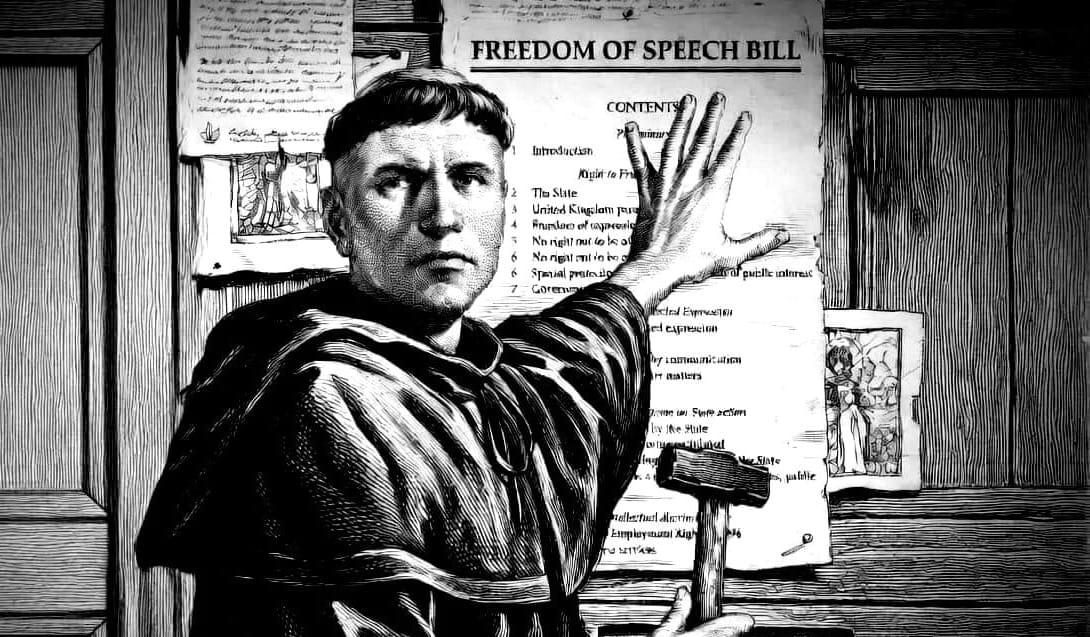
Britain has a variety of ways to destroy you for speaking – many do not realise this, as they have learned to say/think almost nothing at all.
England – and by extension, Britain – once prided itself as a place uniquely adapted to liberty. Today, it leads the English-speaking world in criminalising, and, constraining it. Acts which began life as well-intentioned attempts to curb football hooliganism in the ‘80s, or teenage suicide, have metastasised into a sweeping regime of speech suppression which punishes political dissent more harshly than violent physical disorder. Between the Public Order Act 1986 and the Online Safety Act 2023, the British state has built a censorship machine of considerable breadth – all while ignoring legitimate digital harms, like doxxing, something the state appears to tolerate and even weaponises to political ends.
All are remedied by the Freedom of Speech Bill (2026).
The bill, published in April 2026, aims to address the array of speech issues in Britian and is designed to be adopted by any & all political parties who value The Freedom of Speech. A party which suggests such a bill is not required accepts that they are complicit, or content, with continuing censorship and political punishment. To be charitable, some do not understand how, or why, it is occurring in the first place. Assuming the latter is true, I will break down core problems the British public face, and, how this bill remedies them.
Issue 1: Criminal Speech Law
This is the internationally famous part of Britain's brutality to its citizenry over speech. For the working classes – the plaything, and meat in the meat grinder of our legal system – the restrictions that are faced are usually criminal. You won't hear about these people in the press as speech martyrs, nor can they afford to fight these cases. The state's favoured tools are the Communications Act 2003 s127 for grossly offensive messaging, public or otherwise, along with the Malicious Communications Act 1988 – these two acts lead to around 12,000 arrests annually.
There is also the Public Order Act 1986 s4A, 5 for “alarm and distress” offences. These can be racially aggravated via the Crime and Disorder Act 1998 – that way, the BBC can report your mugshot and call you a ‘Criminal Racist’ for putting up stickers containing truthful material – once accused of the original sin of racism by statutory means, you can be disposed of. 10–15,000 people are convicted under this route annually.
If they would like to go further, there is also The Public Order Act 1986 pt.III s19, which was used lavishly in 2024 after Labour came into office. Following the summer riots, the Labour government seized on it as a Swiss-army knife against white working-class dissent. This requires an imaginary observer believes your words may stir racial hatred – it was used to incarcerate childminder Lucy Connolly, and sentence her to 31 months.
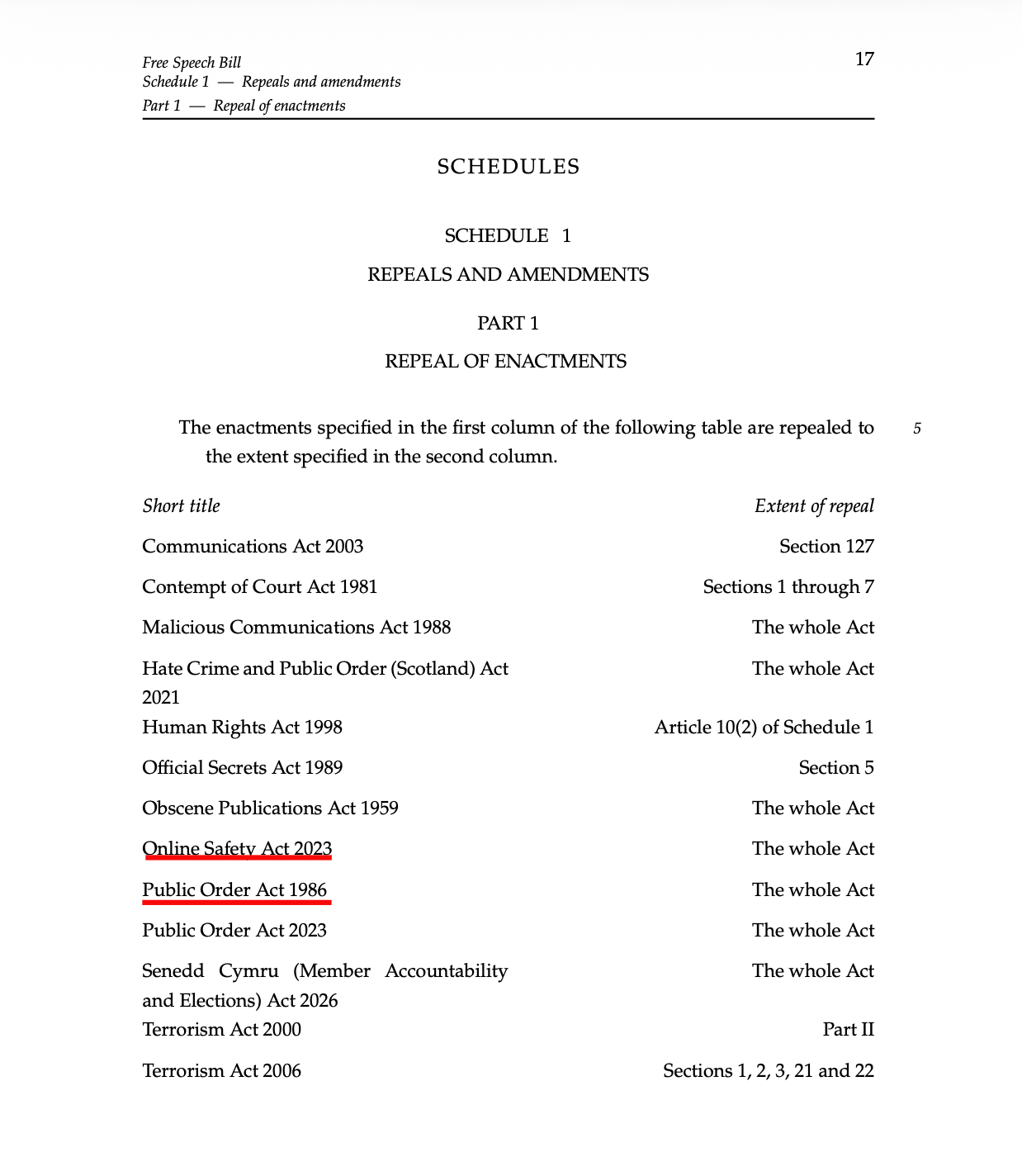
Solution: The Freedom of Speech Bill (2026) repeals all of the above, and pardons those convicted under them (s24 and Schedule 1).
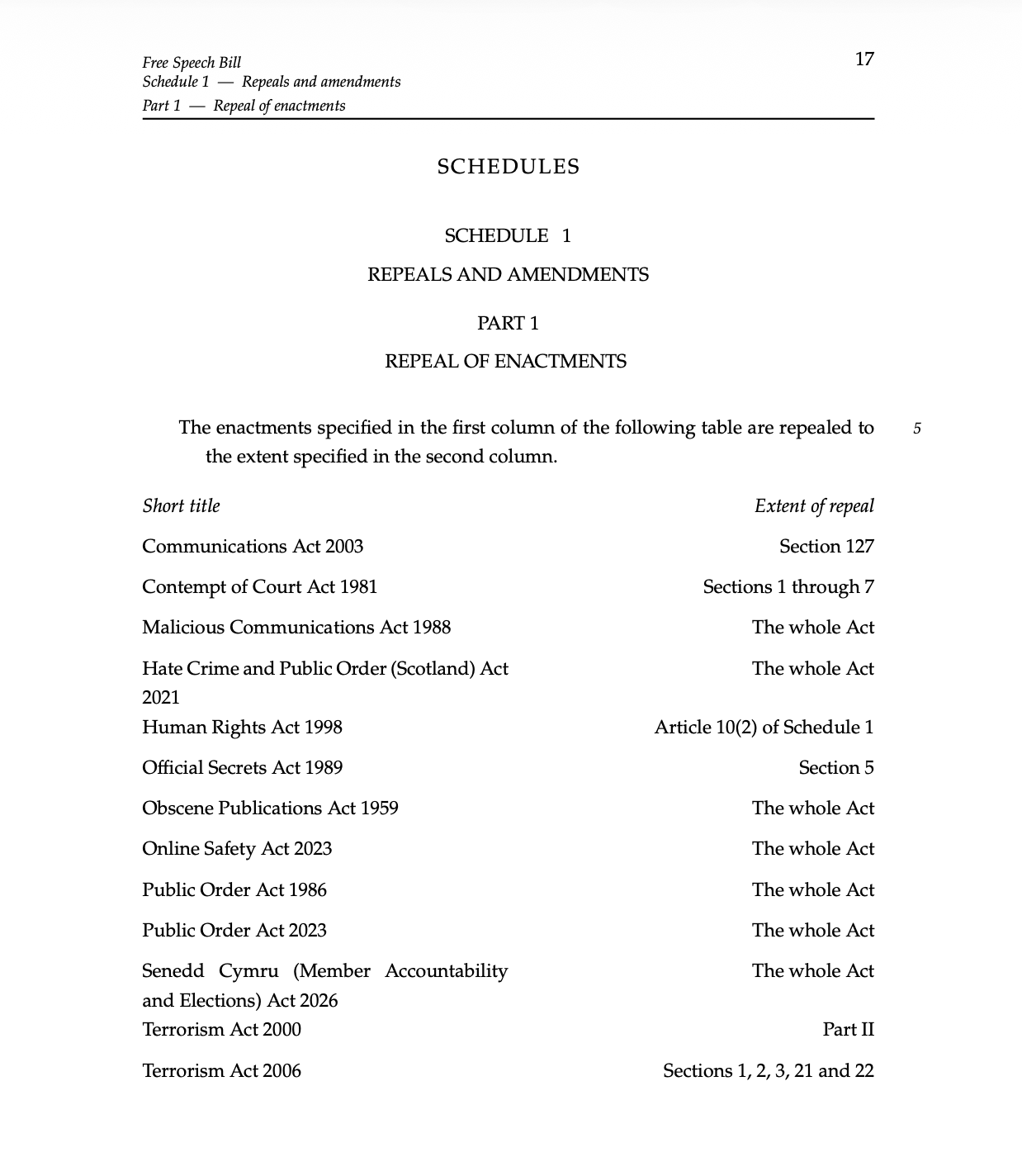
Repeals in the Freedom of Speech Bill (2026), a Schedule 1.
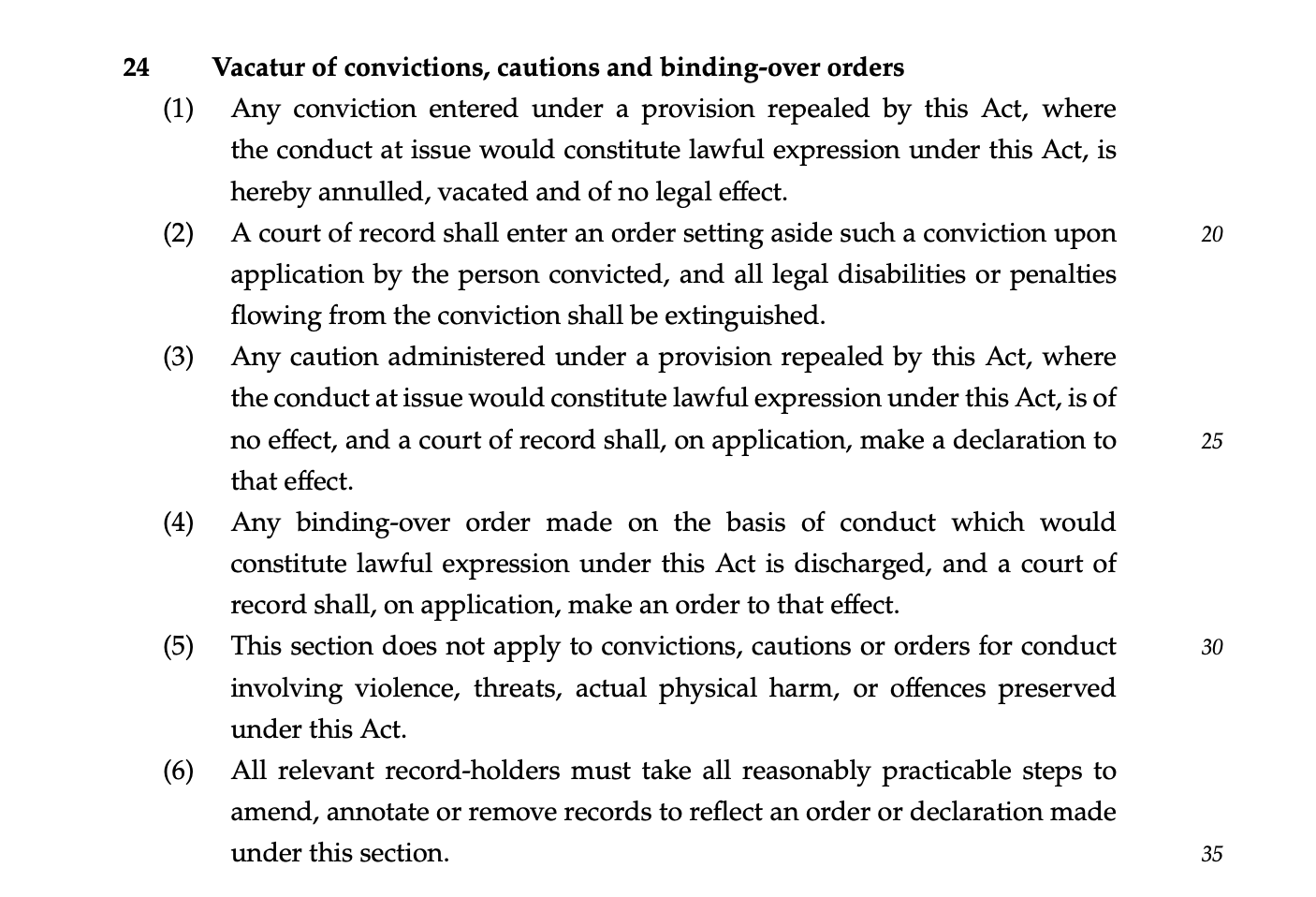
Issue 2: Civil Speech Law & Professional Regulation
For the middle classes, speech will usually be weaponised by denial of entry to public life through sackings, suspensions & strikeoff by professional regulators (rendering years of expensive qualification useless) and finally, smear when financial destitution is not an option. Smear is reserved for when you are self employed in a non-regulated area, for example, youtubers. This is outsourced, by the state, to institutions such as Hope Not Hate. An excellent thread on their ties to the incumbent Labour party, written by Jody McIntyre, can be found here. Another, on their history, is avaliable from Emma Schubart of the Henry Jackson Society, here.
Professional regulation’s power over the individual is under-discussed. The Nursing and Midwifery Order 2001, Health Professions Order 2001, Legal Services Act 2007 and Medical Act 1983 empower regulators to control the speech of professional people (registrants), denying them the ability to work and practice on the basis of their speech. These regulators have routinely expanded their purpose, venturing into and penalising private speech outside of professional duties. The legislation listed above is only a sample; these examples alone empower the state 371,000 healthcare professionals, 800,000 nurses, 300,000 doctors and 192,000 lawyers are asked to keep their mouths tightly shut in order to live and work in Britain. This is why lawyers, for example, are so reluctant speak on matters of clear national interest – sheer self interest prevails.
In ordinary employment law, you can be denied your livelihood for speech, even when spoken outside work. You are forced to rely on ECHR Article 10 and Equality Act's allowances for "philosophical belief" to prevent this; such defences are routinely overpowered, and usually disregarded entirely by internal processes.
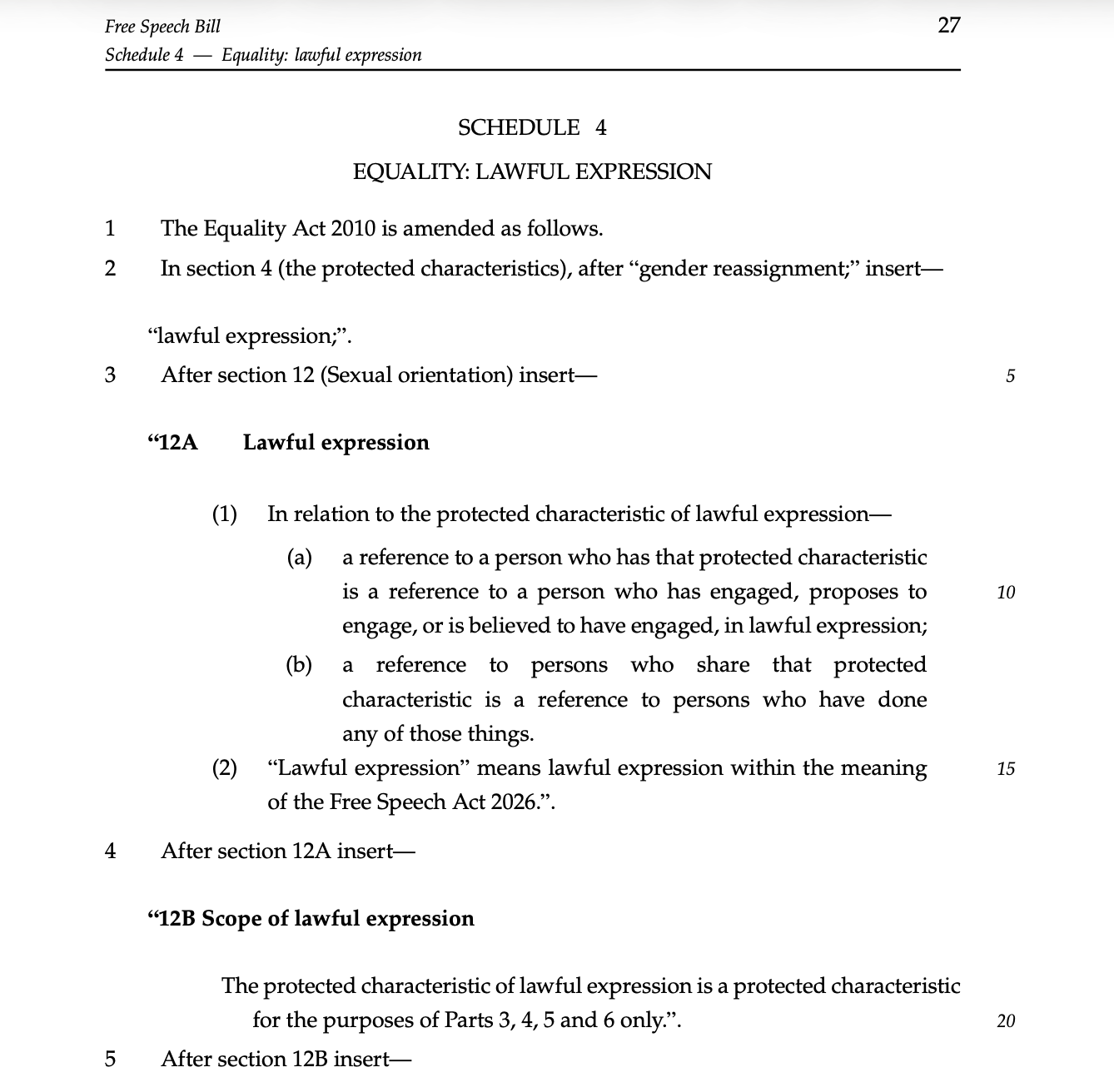
Solution: The Freedom of Speech Bill (2026) disempowers regulators from stepping into the private speech of professionals, and gives you a route to challenge your employer (and win) for treatment based on lawful speech (s13, 15, 16 and 21). Schedule 3 inserts protections for speech outside of the workplace being reason for dismissal through amendment to the Employment Rights Act (1996). Schedule 4 hijacks the Equality Act 2010, routinely an HR department's friend when dismissing you, and inserts "lawful speech" as defined under s4, as a protected characteristic – inverting the HR to homelessness pipeline.
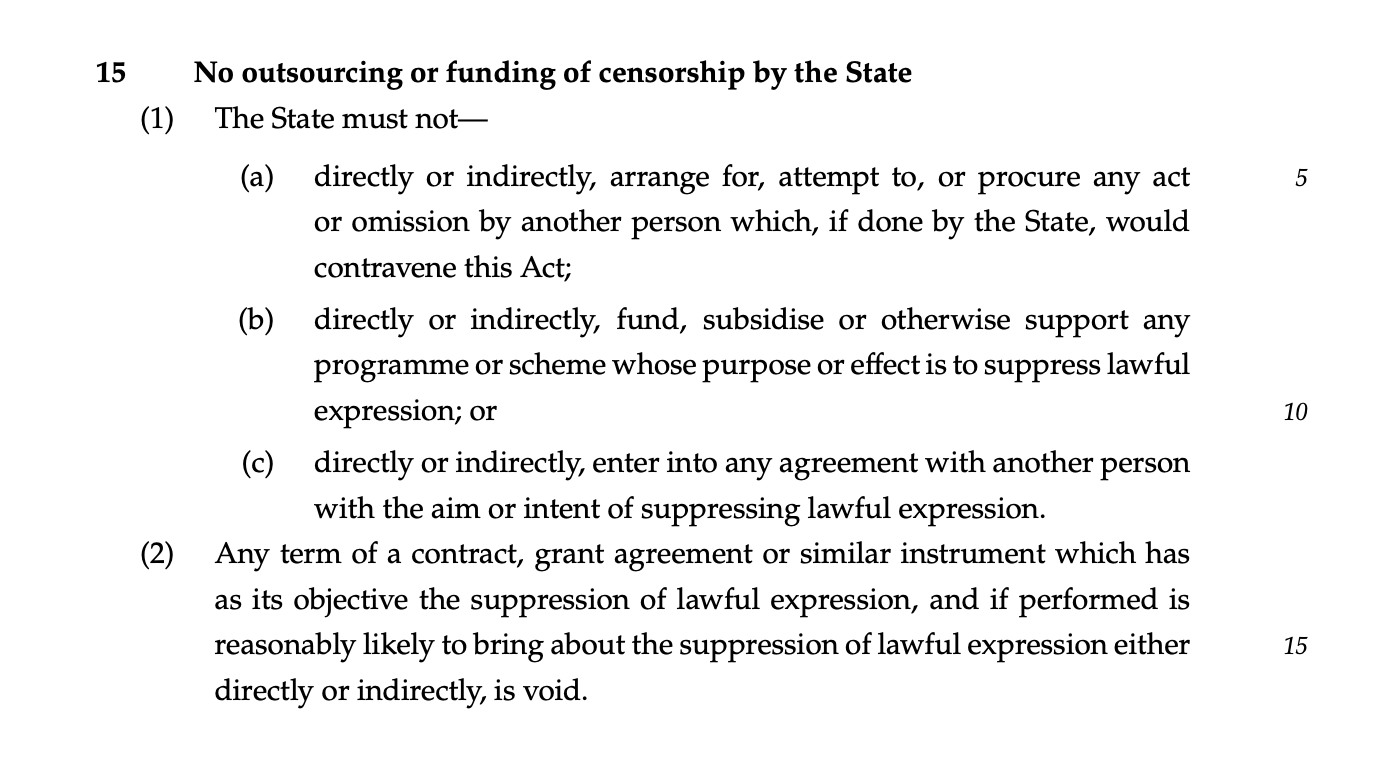
s15 of the Freedom of Speech Bill (2026)
Issue 3: Businesses & The Internet
It now runs through private business. Ofcom already treats broadcasters as responsible intermediaries, with its Broadcasting Code barring “hate speech” and abusive or derogatory treatment unless justified by context, while expressly drawing attention to sections 22 and 29F of the Public Order Act 1986 on material stirring up hatred.
The Online Safety Act extends the same logic to internet companies on a far larger scale. Passed into law in October 2023, it grew monstrous in gestation – fattened by Ofcom’s endless ‘codes of practice’. Ostensibly designed to protect children, it rapidly revealed itself as the most far-reaching censorship mechanism yet devised in a Western democracy. Ofcom can require firms to answer information notices, submit to interviews, and comply with inspection and audit demands; named senior managers may themselves commit an offence if they fail to take all reasonable steps to prevent certain information offences by the company, while other information offences can carry criminal penalties, including up to two years’ imprisonment in the more serious cases.
The genius – if one may call it that – of the OSA lies in its engineered vagueness. Rather than tightly targeting child abuse or terrorism, it grants Ofcom and compliant platforms a catch-all mandate: mitigate any ‘risk of harm’, criminal or not, defined post hoc. Part 3 imposes a ‘duty of care’ on any service offering user-to-user interaction. Section 5 extends this to virtually the entire internet. Section 12 expands ‘content of concern’ to include perfectly legal material deemed harmful by future risk assessments.
Under Section 110, Ofcom can demand access to platforms’ internal moderation systems, source code, or private records – backed by the threat of ruinous fines, and personal criminal liability under Section 176. The OSA also turns the state’s hysteria surrounding misinformation into law. Under Section 179(1), it is now theoretically possible for an April Fools’ joke to land you in court under the offence of knowingly sharing false information which causes ‘non-trivial psychological harm’, with no reasonable excuse. Even claiming that Britain is a ‘free country’ logically risks incurring a criminal charge.
Many businesses, faced with that machinery, will not wait for a court to determine what is truly unlawful. Instead they will comply, implement digital ID checks, and design their moderation systems to err on the side of deletion and suspension of the user. Platforms will not simply remove speech proven harmful. They will be forced remove anything that might become a liability, pre-emptively. Those without the compliance departments to do this, will be forced to close their doors to British users. By March 2025, benign forums – from hamster care groups to cycling clubs – were shuttering under the burden of compliance. The pattern is clear: destroy the free internet’s edges first, and work inward. Welcome to the compliance economy: where the Englishman’s right to speak is strangled not only by a police knock at the door, but by preventing access to public discourse entirely.
Solution: The Freedom of Speech Bill (2026) repeals the so-called Online Safety Act (2023), and the Public Order Act (1986) in full, in Schedule 1.
Issue 4: Institutional abuse of speech penalties for restructuring purposes
For institutions, speech controls are the mechanism by which they have ideologically pruned themselves. Removing any sensible Englishman out (through employment law which allows for this routinely) and turned every office of state and NGO into a hellscape of protocol-oriented bioleninism, through this mechanism. Bioleninism was explained for this publication by John Lucan in March 2026.
In the NHS, in universities, in local government, in regulators, and across the wider public sector, employees are not merely forbidden from saying certain things. They are increasingly pressured to say the right things through training sessions, values frameworks, DEI protocols, disciplinary codes, and the vague language of dignity, inclusion and professionalism. The effect has been to drive out sensible, independent-minded people.
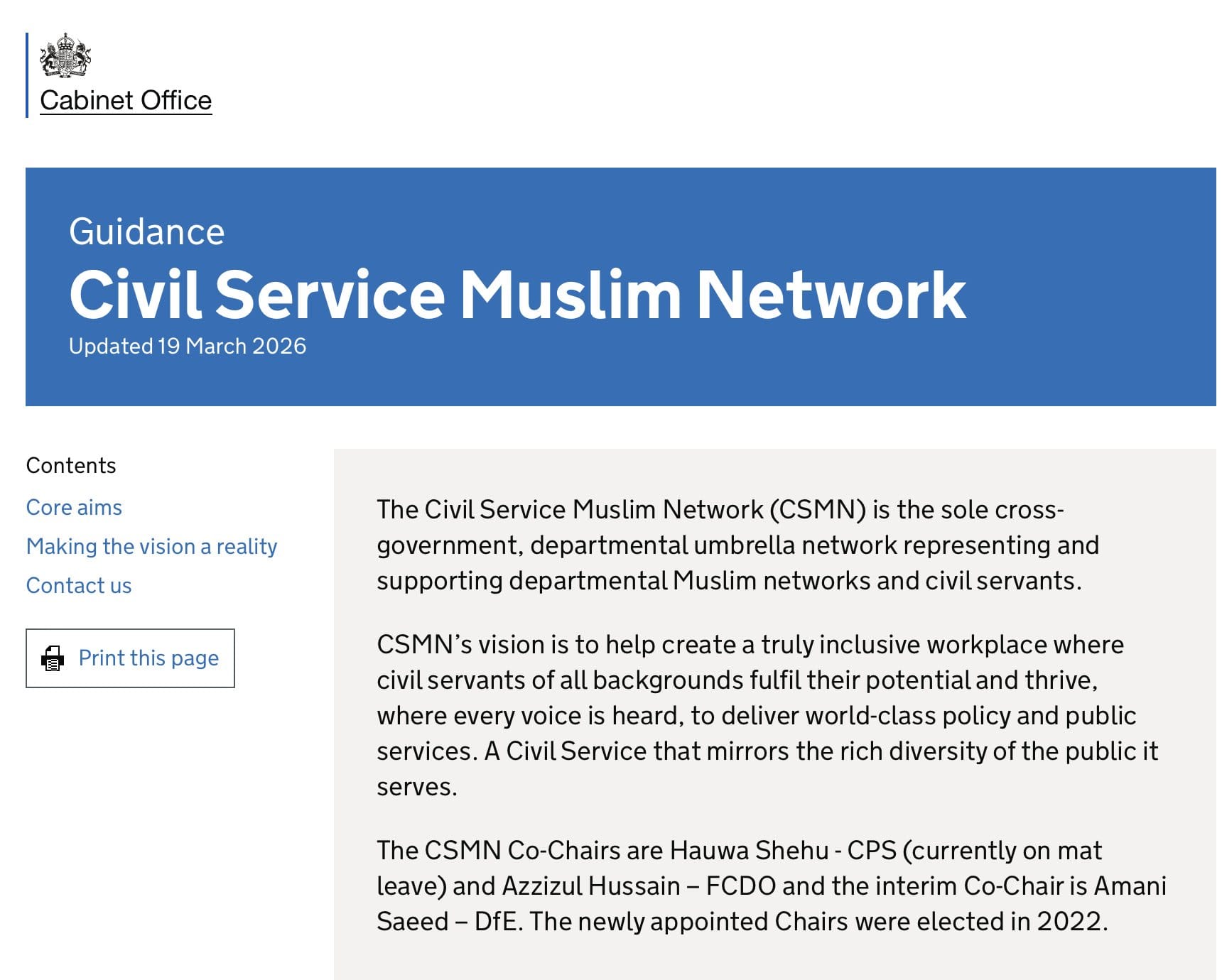
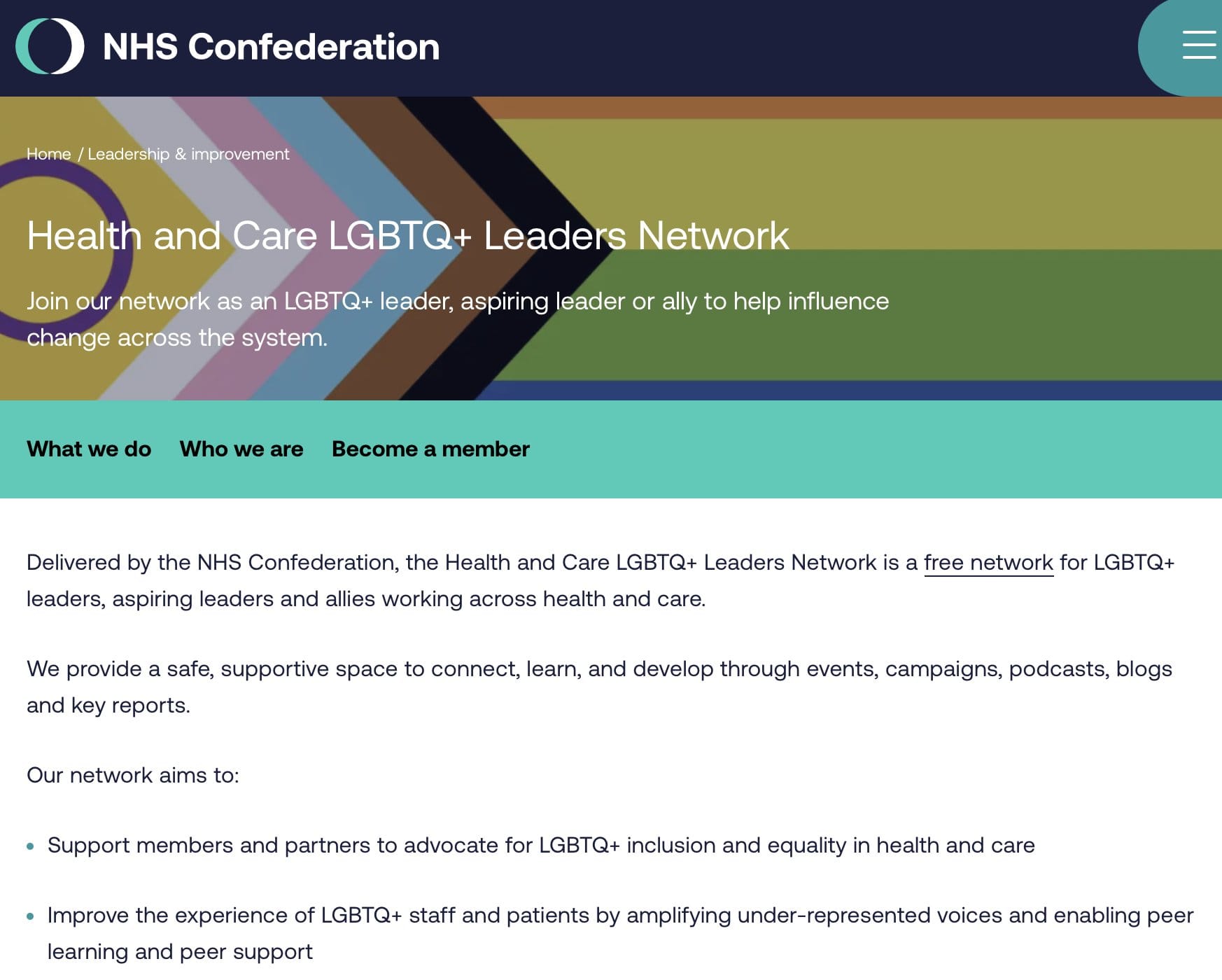
Some examples of major institutions which mandate support as a condition of remaining in employment.
Much of this is the result of a total lack of digital literacy in our judiciary and legislature. 70 percent of court judges and 69 percent of tribunal judges are aged over fifty, and over one-third of both are older than sixty. Most of those involved in drafting and implementing legislation dealing with online speech first meaningfully experienced digital culture upon being forced indoors for two years amid Britain’s COVID-19 lockdown. For a decade, we have witnessed those who do not understand either the law or the internet pushing for legislation on its uses. The same low-information hysteria surrounding the internet explains why the government has treated the fictional Netflix series Adolescence as though it were a green paper.
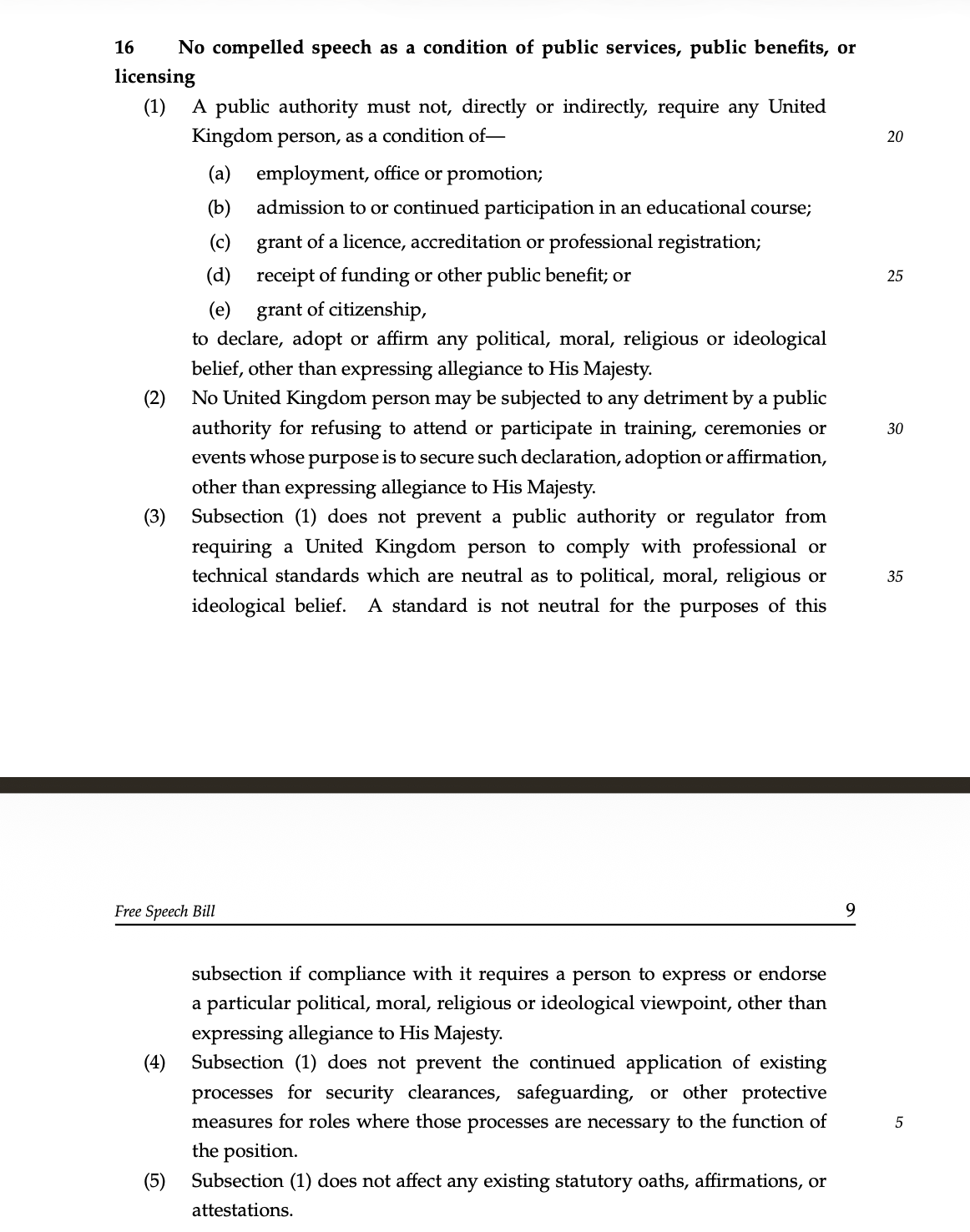
Solution: The Freedom of Speech Bill (2026) s13 bars the State from penalising lawful expression or maintaining codes and policies that suppress it. s16 bars compelled ideological speech in employment, education, licensing, accreditation, funding and public benefits. Schedule 3 protects lawful expression outside work. Schedule 4 protects lawful expression under the Equality Act and bars compelled endorsement of messages or viewpoints.
Conclusion
The obvious answer is repeal. The Freedom of Speech Bill (2026), published by the Adam Smith Institute, offers exactly that, alongside clarity, and narrow definitions of speech which can become 'unlawful'. Until Britain makes the choice to adopt the bill, our nation will remain a cautionary tale in the realm of incremental censorship.