
The Progression of Liberty: 1688 Britain, 1776 America, now, 2026 Britain Again
Richard Orr argues that Britain's eroding freedoms echo two pre-revolutionary eras – 1688 and 1776 – and that the Adam Smith Institute's Freedom of Speech Bill (2026) offers a chance to reclaim an inheritance most Britons have forgotten they ever had.

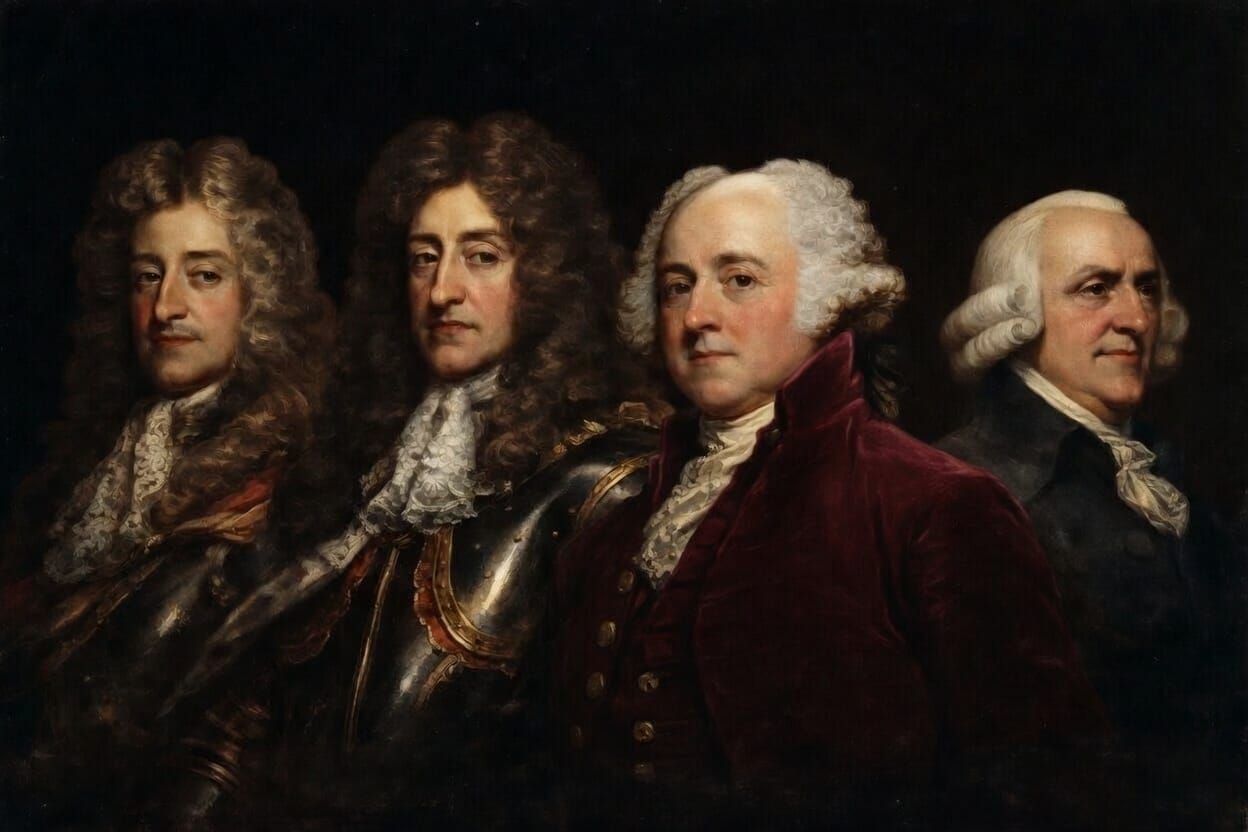
Ancient legal liberties eroded. Arrests for “seditious words”. Arrests for “false news”. Words are violence – scribere est agere, or “to write is to act”. Britain in 2026 can read uncomfortably like two pre-revolutionary eras of the past: America in 1776, which was inspired by Britain in 1688. Two eras, philosophically intertwined, in which experiences of tyranny created an urgent desire to restore liberty.
“The Declaration (of Independence) was in the main a restatement of the principles which had animated the Whig struggle against the later Stuarts and the English Revolution of 1688.” – Winston Churchill, A History of the English-Speaking Peoples, Volume II (1956)
“… The [American Revolution] movement in the beginning was based entirely on the traditional conceptions of the liberties of Englishmen… They felt that they were upholding the principles of the Whig revolution of 1688…” – Friedrich Hayek, The Constitution of Liberty(1960)
America’s Documents of Liberty
This year is the 250th anniversary of the United States of America, a nation that reveres its founding documents. In Washington, DC, the National Archives Museum is a temple to what the late historian Pauline Maier described as “American Scripture”. In its cathedral-like rotunda, a visitor can see the Declaration of Independence, the Constitution of the United States, and the Bill of Rights. Significantly, alongside them sits an original 1297 Magna Carta.
These American founding documents were written by British subjects, many of whom until the summer of 1776 still wished to remain so. The content of each drew upon understood British liberties. All three entered the American constitutional tradition as a response to governmental overreach from London that, in colonial eyes, had suspended or violated those liberties. The people of the Thirteen Colonies were not anti-British in any simple sense; in legal and constitutional terms, they wanted to be fully British, not second-class citizens in a transatlantic two-tier system. Independence was forced upon them as the means by which they might reclaim what they took to be their inherited liberties, and build a new nation philosophically grounded in ancient British freedoms, with important adjustments of its own.
“History in general only informs us what bad government is, but as we have employed some of the best materials of the British constitution in the construction of our own government, a knowledge of British history becomes useful to the American politician.” – Thomas Jefferson (1807)
Britain’s Documents of Liberty
The British predecessor-documents to these American texts had been written roughly three generations earlier, in the 1680s, during the era of the Glorious Revolution. They too were written into law as the result of state overreach and political crisis. Yet today these documents are barely known on this side of the Atlantic: obscure, neglected, almost forgotten. We have no equivalent cathedral to our own lineage of liberty. We have little knowledge of our ancient rights.
“We make men without chests and expect of them virtue and enterprise. We laugh at honour and are shocked to find traitors in our midst.” – C. S. Lewis, The Abolition of Man (1943)
The British subjects who later became the “Founding Fathers” of the United States knew these late-seventeenth-century British documents intimately, and cited them often. The colonies also possessed individual charters, several of them shaped in the same wider constitutional world. Colonists treated this collection of texts as a kind of constitutional inheritance – a framework within which they could justify resistance to the growing oppression of a London government in which they had “no representation”. To them, the crisis of the 1760s and 1770s often felt like a rerun of what they had read of Britain in the 1680s. Other political writings from that earlier British crisis were reprinted in revolutionary America. Among English writers, John Locke and Algernon Sidney were among the most cited by the American revolutionary generation.
When pushed toward independence by punitive legislation from London - including the Intolerable Acts, the Restraining Acts, and the Prohibitory Act - the Americans adapted elements of those earlier British constitutional arguments for the Declaration, for the Constitution of the new republic, for the constitutions of individual states, and later for the Bill of Rights. In some places the resemblance was very close indeed.
1660s–1680s: Tyranny in Britain
A ruler who insists that he may govern absolutely, with the “Divine Right” sanction of God, claims by implication the power to silence anyone who dissents. Charles II returned to the throne in 1660, and the Restoration settlement soon imposed severe restrictions on religious nonconformists through what became known as the Clarendon Code. Arrests of prominent dissenters followed, especially in Scotland, as did punishments and executions. These laws did not merely restrict freedom of religion; they also constrained movement, public assembly, and civic participation. Some were arrested for distributing literature deemed “seditious and schismatical”.
1680s: John Locke and Algernon Sidney – “To Write Is to Act”
Somerset-born John Locke had once worked within the system, helping to draft the Fundamental Constitutions of Carolina in 1669. But as the crisis deepened, Locke fled to the Netherlands in September 1683. Another political thinker, Algernon Sidney, had already been arrested and charged with treason. At Sidney’s trial, his unpublished manuscript of Discourses Concerning Government was used against him. The principle was chilling: writing itself could be treated as action, and thought as deed. Sidney was executed at Tower Hill on 7 December 1683.
Locke, meanwhile, remained in exile in the Netherlands, where he worked on writings including A Letter Concerning Toleration and the ideas later associated with Two Treatises of Government. While Locke wrote in Holland, James II came to the English throne, presenting himself in effect as another absolute monarch.
1685: Rebellion and the “Bloody Assizes”
In Locke’s home region of south-west England, the brief Monmouth Rebellion of 1685 broke out against James II. It failed, and the aftermath was barbaric. More than a thousand men, and some women, were arrested and tried in proceedings remembered as the Bloody Assizes, presided over by George Jeffreys, now Lord Chancellor to James II. Legal process was bent to exemplary terror. Jeffreys became notorious as the “Hanging Judge”. Hundreds were executed or transported; in the West Country, the punishments were deliberately theatrical, meant to overawe entire communities. A writer of the period described the region as “an Aceldama”, a field of blood.
This history still lingers across the south-west today. At Taunton, one can still trace the geography of those punishments. At the Museum of Somerset, meanwhile, hangs a portrait of Locke from the studio of Sir Godfrey Kneller, painted in 1704, the year of Locke’s death. His long silvering hair and heavy-eyed face convey something of a grave but gentle determination. His arguments in Two Treatises outlived him and crossed the Atlantic. The museum’s caption neatly summarises that legacy: government should rest on consent, and some fundamental rights belong to all people. His influence on the founders of the United States was immense.
The 1688 Declaration
The powers of Europe, France excepted, came to believe that James II had to be removed. The chosen leader of the coalition was William of Orange, Stadholder of the Dutch Republic. The famous letter of the “Immortal Seven” informed him that many in England were “desirous of a change”. William’s wife, Mary, was James II’s daughter; the aim was to replace James with a joint monarchy of William III and Mary II. The enterprise required unprecedented publicity. Locke, still in exile, may have had some involvement in the intellectual milieu around the Declaration of His Highness William Henry, Prince of Orange, published at The Hague on 10 October 1688. Its principal author was Gaspar Fagel, and it was translated into English by Gilbert Burnet. Tens of thousands of copies were printed and circulated across Europe.
The vocabulary and format of the 1688 Declaration are striking. Its opening declared:
“It is both certain and evident to all men, that the public peace and happiness of any state or kingdom cannot be preserved, where the laws, liberties and customs, established by lawful authority in it, are openly transgressed and annulled…”
The resemblance to the famous preamble of the Declaration of Independence is hard to miss: “evident”, “all men”, “liberties”, “happiness”.
“We hold these truths to be self-evident, that all men are created equal, that they are endowed by their Creator with certain unalienable Rights, that among these are Life, Liberty and the pursuit of Happiness. That to secure these rights, Governments are instituted among Men, deriving their just powers from the consent of the governed…”
The 1688 Declaration continued with a long catalogue of grievances against the existing government; the 1776 Declaration likewise set out a sustained indictment of the Crown. The resemblance should not surprise us. Thomas Jefferson, principal drafter of the Declaration of Independence, had studied law at the College of William and Mary in Williamsburg, and his Summary View of the Rights of British America had already established him as a constitutional polemicist of the first order.
The 1688 Revolution
William’s pan-European liberation force landed at Torbay on 5 November 1688, in Devon, one of the counties scarred by the repression of the previous years. Copies of his Declaration were distributed as the army advanced toward London. It was read publicly at Newton Abbot and formally proclaimed in Exeter. It was posted at Plymouth, where support shifted decisively. William’s advance was, in effect, unopposed. James II fled to France, and it was resolved that he had abdicated the government and that the throne was vacant.
The 1689 Bill of Rights and “Freedome of Speech”
With the Revolution secured, Locke returned to England in 1689. William and Mary were offered the crown, and their coronation took place in Westminster Abbey on 11 April. Their first constitutional act was to accept a Declaration of Rights, later enacted as the Bill of Rights, whose full title was An Act declaring the Rights and Liberties of the Subject and Settling the Succession of the Crown. Drawing in part on earlier constitutional struggles, it responded directly to the overreach of the previous reigns and sought to guard against its return. It replaced the logic of absolute monarchy with a system of limited monarchy, in which the Crown was subject to law and Parliament. Among its most famous clauses was the protection that “the Freedome of Speech and Debates or Proceedings in Parlyament ought not to be impeached or questioned in any Court or Place out of Parlyament”.
“… all and singular the rights and liberties asserted and claimed in the said Declaration are the true, ancient and indubitable rights and liberties of the people of this kingdom.”
William and Mary, in effect, accepted a settlement that limited their own power. American scholars tend to focus more on the 1689 settlement than on William’s 1688 Declaration, but the two belong together. One announced the restoration of laws and liberties; the other entrenched them in constitutional form.
“Were I to define the British constitution, therefore, I should say, it is a limited monarchy… for the preservation of the subjects liberty.” – John Adams (1766)
“I … would rather be in dependance on Great Britain properly limited than on any nation upon earth, or than on no nation.” – Thomas Jefferson (1775)
The Freedom of Speech Bill (2026): Renewing the Inheritance
In 2026, this constitutional lineage has acquired renewed urgency in Britain. The Adam Smith Institute’s Freedom of Speech Bill, drafted by Preston Byrne, Michael Reiners, and Elijah Granet, represents one of the most ambitious attempts in recent British history to codify free expression as a positive constitutional right, rather than a residual liberty that survives only so far as the law has not yet restricted it.
The Bill’s authors note that thousands of citizens are arrested each year in Britain for what they say online – sometimes for speech that is merely offensive or ambiguous, often under the sweeping provisions of the Online Safety Act, the Malicious Communications Act, the Public Order Act, and the Obscene Publications Act. As the constitutional scholar Adam Tomkins, John Millar Professor of Public Law at the University of Glasgow, has noted, recent cases – encompassing journalists, activists, and public commentators across the political spectrum – demonstrate how poorly-drafted laws, inconsistently enforced, are corroding the culture of open expression.
The democratic cost is measurable. Polling by Lord Ashcroft found that 42 per cent of people in Britain have stopped themselves from expressing their true opinions on controversial matters. Self-censorship on this scale is not the hallmark of a confident liberal democracy; it is the symptom of one in which citizens no longer trust that honest speech is safe.
The Freedom of Speech Bill proposes to remedy this by enacting something close to a First Amendment for Britain: a statutory guarantee of freedom of expression, binding on public authorities, with narrow and objectively defined exclusions rather than the broad, discretionary restrictions that currently prevail. It would also, notably, place positive duties on the state to refrain from withholding information from citizens, except on grounds of genuine national security. In this it echoes the spirit of the 1689 Bill of Rights: not merely removing a particular tyranny, but building a legal architecture to prevent its return.
The existing framework offers partial protections. Article 10 of the European Convention on Human Rightsguarantees freedom of expression, but in qualified and judicially negotiable terms. The Higher Education (Freedom of Speech) Act 2023 created fresh statutory duties around lawful speech and academic freedom within universities, with Office for Students guidance explaining how those duties should be secured in practice. These are welcome, but they remain sectoral and incomplete. What the Adam Smith Institute proposes is general: a constitutional commitment to free expression that applies across British public life, not only in lecture halls.
Conclusion: Transatlantic Liberty Today
The point is not that 2026 Britain is simply 1688 or 1776 in modern dress. History does not repeat itself so neatly. But constitutional memory matters. A society that forgets the lineage of its liberties will struggle to recognise their erosion when it comes in contemporary language, under contemporary bureaucracies, and with contemporary justifications.
That is why present debates over free expression matter. The Freedom of Speech Bill can be read as an attempt to push the argument further: to restate freedom of expression not as a managerial privilege to be balanced away at convenience, but rather, as a constitutional liberty that deserves firmer and more general protection after the damage has been done to Britain's jurisprudence. Whether or not one agrees with every part of that proposal, it belongs to a recognisable Anglo-American tradition – the insistence that liberty must be positively secured in law, not merely invoked in rhetoric.
That was the lesson of 1688. It was also the lesson carried across the Atlantic in 1776. Thomas Paine, great contemporary of Adam Smith, captured the spirit with characteristic bluntness: “he who dares not offend, cannot be honest.” The question for Britain now is whether it still remembers enough of that inheritance to renew it.