
Unhappy Anniversary
Dr Chris Syn’s 'Unhappy Anniversary', a prose poem & lyric essay on the Russo-Ukranian war marks its date-anniversary. It follows the old corridors of grain and trade from the Black Sea to Kiev, and asks what porous frontiers, EU satrapies, and war-scorched breadbaskets foretell for them.

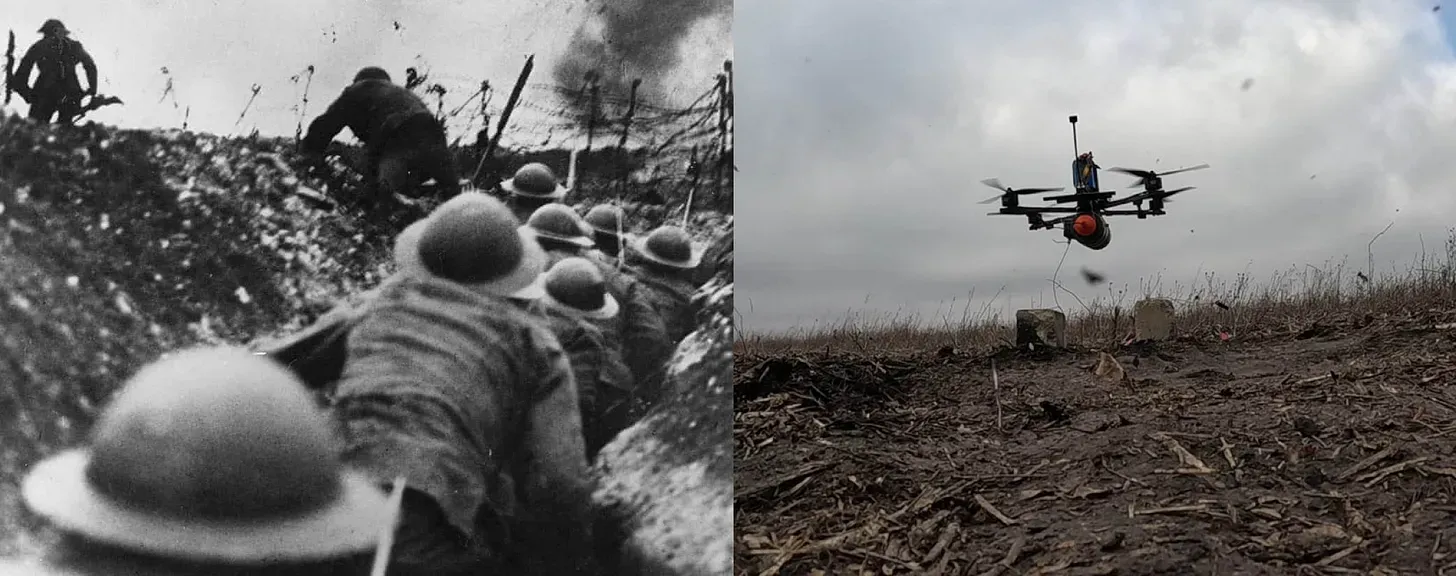
As in a fortnight we reach the most pivotal date-anniversary of the Russo-Ukrainian War, grim enough, even despite its now reminiscent duration to that of another, profound continental wound, it may, to some at least, be worth sharing the conclusions alighted at the other evening, with an old strategic colleague of mine.
Pedestrian though these may at first seem.
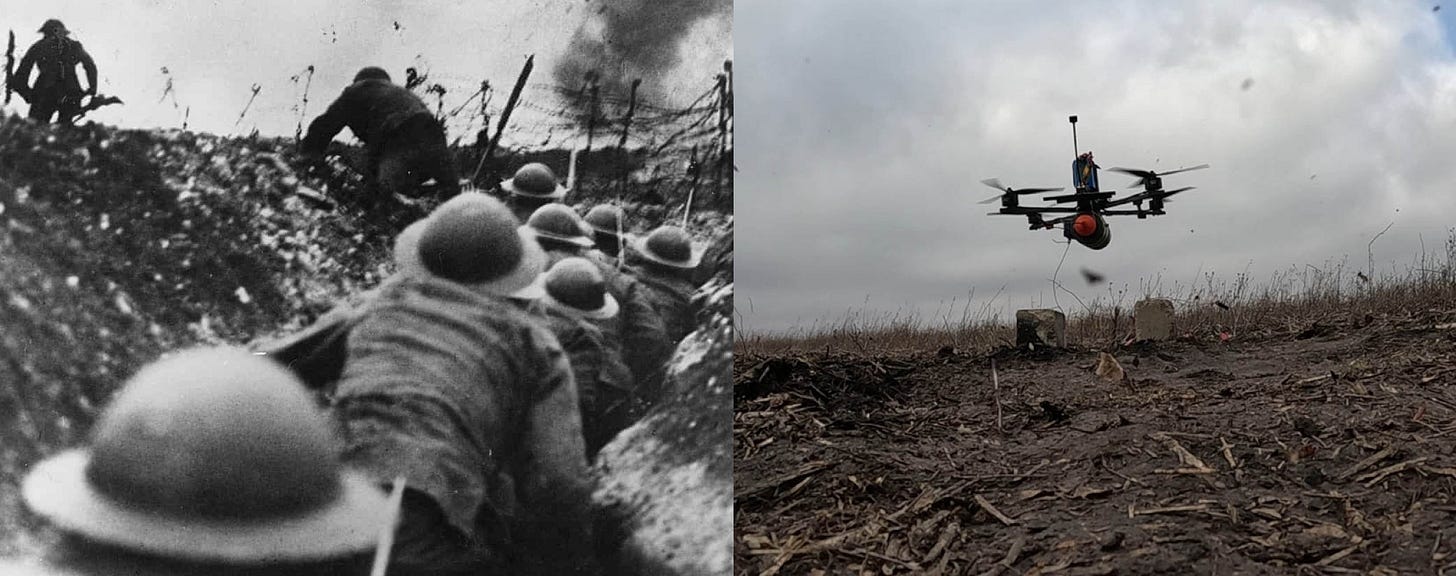
Our mutual reflections resolved into a conviction that, to the Slavic populations dominating eastern Europe at least since the Mongols, this likewise four-year war has had a somewhat parallel, traumatic impact.
In its mirrored elimination of the flower of courage, youth, and ability, in a White population stretching up to the Urals; this time around. An impact of a scale, to that of the First World War, which, while itself possessed of its own eastern fronts, nonetheless constituted an increasingly, genetically-acknowledged decimation, of a once European west.
The byproduct? A dysgenic de-evolution.
And one to which so many now ascribe the incremental implosion, in its wake, of the influence, confidence and fertility of European powers. Forming as these all have a demographic vacuum, into which the former Third World continues to rush unabated.
Put simply, while Prof. Niall Ferguson used to warm to the convincing theme of 1914-1945, as in fact being, Europe's civil war: to the two of us, a similar internecine spasm of kinetic self-destructiveness had taken shape whose wider ongoing impacts can only be hazarded.
With a singular exception, of course.
Subject more to repulsive Telegram videos than amaranthine poetry, the ubiquity of drone deployment, to say nothing of electronic warfare, and the growing infrastructure sabotage of external allies — springing from a Sarmatian Plain, made conflict laboratory — have all likewise changed the nature of future war in unprecedented directions, and irreversibly.
As inter alia poison gas, creeping artillery/tank barrages, and naval food blockades had all previously done; emerging as these did from years of (similarly Caucasian) Flanders stalemate.
But in the Great War’s time, neither the UK’s denizens, nor Canadian or Australian combatants, would have called themselves Europeans. More British, or simply as Britons in the main; the self-regard of that great country turning up in 1917 even less so, that of their continent ab-origine.
So, while the interim has witnessed the un-melanated dwindle, to a small fraction of the global population, the continental expanse deemed Europe, by contrast, has only grown eastwards to match the conventions of geography.
Certainly to those, in Brussels, clamouring for the Ukraine’s EU accession.
But this reality makes the conceptual effort to cleave off machinations in Moscow, likewise the majority whom the Kremlin has deployed, as something separate and other, to be quite absurd. In our today, these antagonists are far more “of us,” than they ever were, while still serf-subjects of Queen Victoria’s own fecund brood.
With no Versailles or lamentable Trianon in sight, however, it was not the plainly failed-at intention of our evening’s, coalescing consensus, to make prosaically dull statements over revolutionary, permanent changes, in respect of which the wider globe (again and also) remains quite unready.
Not so. Not even from this virgin Substacker, who long ago had mused on, “the last European century;” and more clichéd notions still. That our own wider continent, for example, even so diminished, shall regardless remain the anvil of human history.
For these, in our mutual analysis, might all be thought value judgements of one stripe or another, and rightly. The purpose we had truly aimed at, being, only to try and grasp (through living in the future, somewhat) how decades to come, would likely in retrospect come to see our own.
Perhaps, as the 2020’s constituting a quite predictable end-point.
Of how those very, and aforementioned, sea blockades, would give way in short order to great Atlantic and Arctic convoys.
It being nonetheless undeniable that computers, whose mundaneness no one can now imagine living without, similarly sprang from the accelerant of human development that intra-European conflict has long represented.
Much like the rocketry devised and deployed, by the other side (whose cryptography desperately needed decoding), without which Starlink-guided drones could target neither Slav nor APC; and don’t even get me started on the Proximity Fuze.
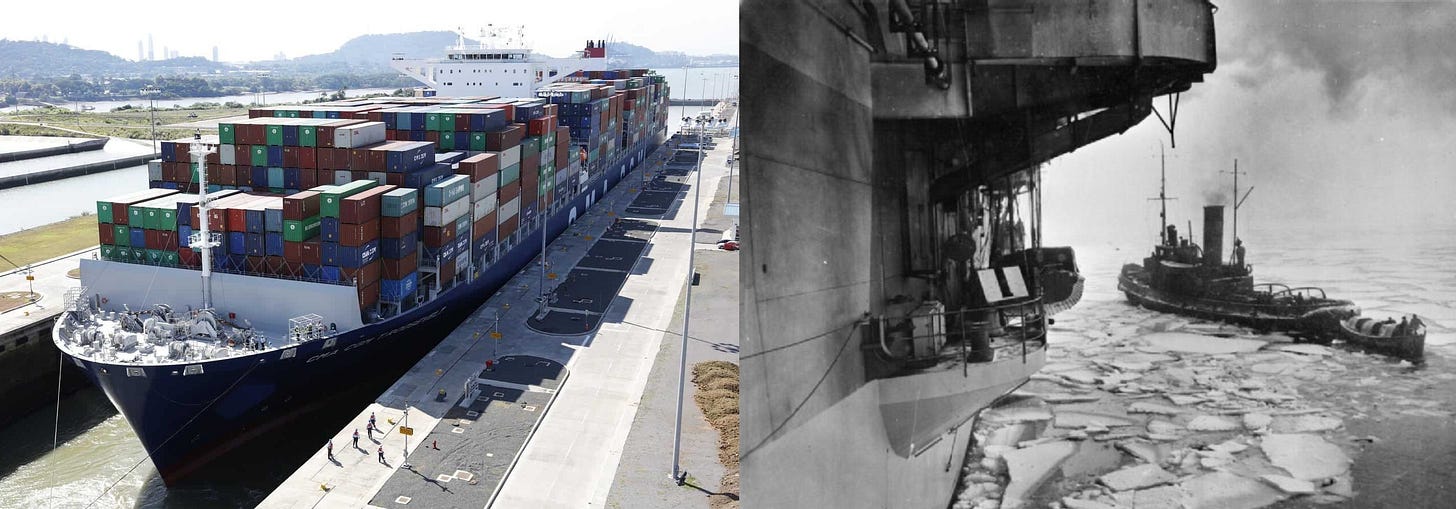
Alan Turing, despite being as much of a future dweller as Wernher von Braun, while striving to save seamen from icy U-boat dug graves, could little have imagined his guarded convoys and SigInt, in turn, acting globally as oceanic pioneers.
For the eventually vast transportation of ores and containers.
In a transcontinental criss-crossing of sea routes made so ordinary that, an eventual tandem growth, should have been foreseeable, into huge movements of more bodily resources. And by the millions: in persons, rather than in commerce.
With it now rather difficult to disentangle or distinguish, the skyward tree trunk, from the creeper so tightly wrapped around, and rising with it, also.
Seeing how, truly, globalized goods then finance and then instant communications, all with onetime “brother wars” — Caucasian corpses, let us be frank — as their initial pathfinders: could only ever result in endeavours by human fruits (to put things clumsily), following those transport pathways, first established to ferry the fruits of human endeavour.
And were this to be true?
Then, we alight at something beyond Black Sea transiting grain, without which much of Africa would soon starve. Past the war depopulating, vast arable regions, that the Berlaymont covets for its own; soon, also non-white population centres. (In a solely geographically, European west, that is.) Through making Kiev the divisional HQ of another EU satrapy.
With such farmlands, the richest source of flour in the entire world, made far more vital, than when the serfs who tilled it merely sustained the Romanovs in a wealth that could splurge on Fabergé eggs.
We all arrive at a place where, even those far flung nations, in a multipolar world, currently counting themselves more ascendant, might begin, too late, to notice a similar trajectory. Through their simply ending up with more, over time, be that measured in wealth or comfort, rather than less.
Despite presently acting as twenty-first century exporter-countries of people, while increasingly regarding Europa as an irrelevantly febrile backwater, or one at least, quite incapable of resisting its own well-merited neocolonisation.
Their own location as distant states, the eventual product, in years whose brevity are a trifle to the human mind’s mother continent, of yet another evolution.
Towards eventually finding out, most likely, that economic pressures, entailing any frontier’s greater porosity — be it to goods one way, or migrants the other — make a somewhat inadequate longterm guardian, of internal ethnic integrity.
What with the European Union, in just one example, taking an eraser, to the settlement of Westphalia. Similar erasers having only roamed across the wider world’s borders, ever since.
My longstanding Caribbean friend could not help but chuckle, at there being an undeniably depressing certainty, to any Austro-Hungarian, eventually finding himself groping towards the principles of autarky.
Such Eurocentricity… in so forthright a final insistence!
That no matter our continent’s diminution, we would still, in war, and all that is culturally and ideologically downstream of it, be the racial composers of the world’s symphonies.
Those to which all other peoples in the fullness of time will also find themselves dancing; be their great European conductor living, or as dead as a beehive’s cell, turned mausoleum.
Reminiscent in darkness to burned out husks made of the housing estates of Luhansk.