The New Y2K. (September 12, 2018)
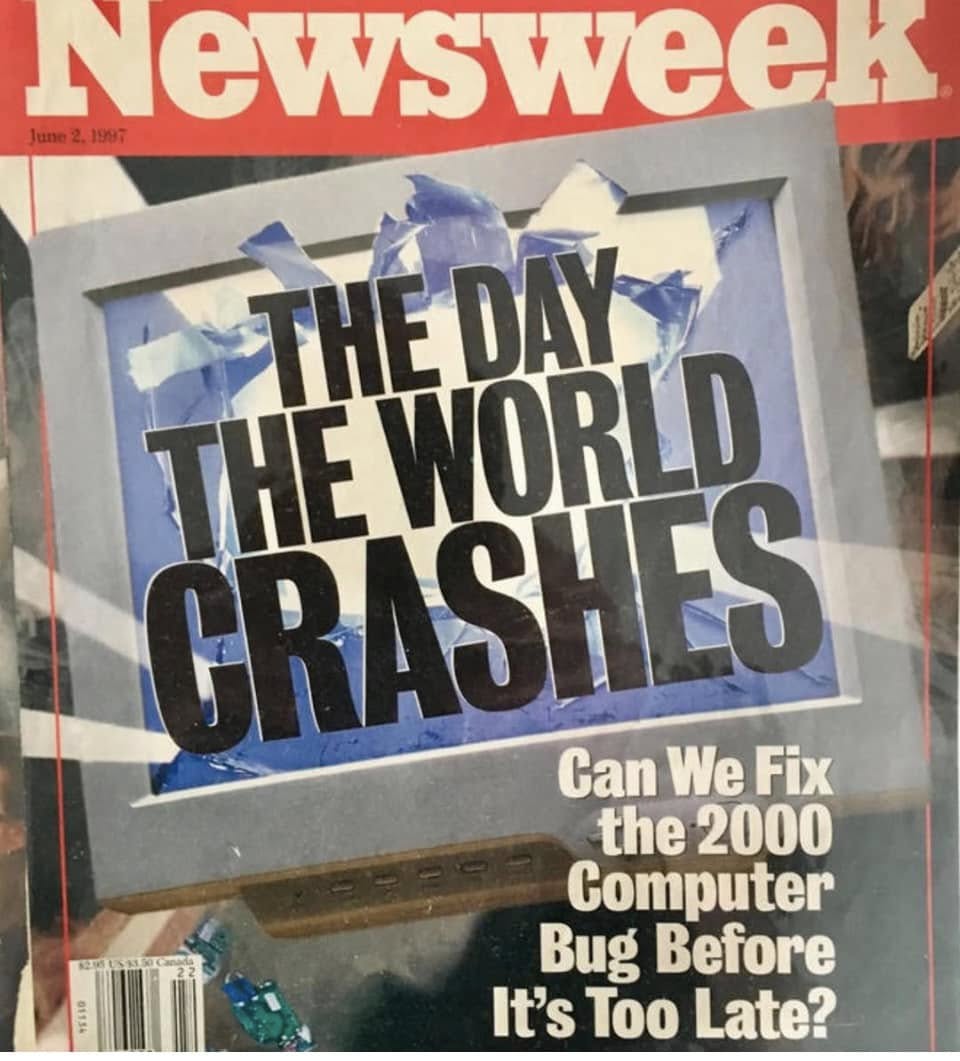
Michael Reiners discusses how changing user-behaviours, predatory business practice and intense desire for regulation represent the death of the modern internet – an event akin to the 'Y2K' Millennium bug.

I have had the privilege of having being raised one-foot in reality, the other in the fiction of social media. My age-range treated the internet as a similarly aged sibling, coming of age at the same time as they did. Those growing up today, cradle-to-grave online, will instead have the experience of the internet being more akin to an abusive parent. The monopoly on communication Facebook now holds hadn't fully ‘set-in' during the years that shaped my pre-adolescent self. It certainly had by 2014, and in a fashionably late style, only now are traditional media and legislators noticing (and anxiously catching up). This rapid catchup is largely due to the sudden realisation in 2016 that such monopolies have an impact on political discourse. Recently, The European Parliament voted in favour of the Copyright Directive on September 11th, an act with implications oddly reminiscent of the Patriot Act, which followed the events of September 11th 2001. Another catch-up attempt comes from within the United Kingdom, with Labour MP Lucy Powell motion for consideration of a bill which would ‘ban' private Facebook groups, something she considers a conduit to "the rise of the far right", something of a recurring theme in government's recent attempts to catch up.
So, just who has been on the ball when it comes to censoring the radical extremes online? In 2012, Russia caught up, introducing a ‘single register' which censored IPs, URLs and Domain names advocating illegal activity following a spike in drug use. However, the register later was amended this to include a ‘Federal list of Extremist Activities', an amendment which is frequently abused to suppress alternative ideas, online representation of the LGBT community, and of course, criticism of the federal or local government (according to NGO Freedom House). China was particularly ‘ahead of its time’; the nation blocked Facebook nationally in 2009, a time before citizens in the Anglosphere were taking ‘social media breaks' or even knew how to pronounce meme, let alone suggest such things may well be responsible for electing president Donald Trump.
Just how did these nations become so prematurely ‘woke' regarding the threat of radicalism? Are we perhaps on the wrong side of the Berlin Firewall? The European Union appears to think so, and, has been in a deadlock with Facebook, Google and co in recent years over issues ranging from taxation to freedom of speech and expression. September 11th's Copyright Directive attempts to address the latter. Article 13 of this directive effectively requires that all data uploaded to sites such as YouTube or Facebook must be scanned to stop users from sharing unlicensed copyrighted material. That includes the license holders of anything from cringe-inducing stock photos to gifs containing scenes from a feature film; fair use appears to be in dire retreat. Not only is this an incredible burden for smaller platforms and sites who lack the revenue to carry out this monumental task, but more worryingly, a mechanism easily applied to widespread censorship. Machine learning has already proved that highly specific information can be detected en-masse when it comes to music licensed by WMG or Sony, compared to this, alleged incidences of hate speech from over ten years ago are easy pickings. Article 11, on the other hand, attempts to make the Mark Zuckerberg's of the world economically accountable to news outlets; it has been dubbed the ‘link tax' by critics and requires sites like Facebook to pay news outlets to share their content on their platforms merely. This move, oddly, economically incentivises misinformation in the face of exorbitant taxation.
In this same vein of misinformation, Labour MP Lucy Powell, writing in the Guardian, suggests that private Facebook groups are "online echo chambers are normalising and allowing extremist views to go viral unchallenged" while in the ‘real world', she suggests, such misinformation or extremist views would be challenged. Indeed, extremist views are challenged all the time, both online and not, by people like Powell and by many many others; the Overton Window of acceptability has closed to near shutting-point online in recent times, and consequentially, also offline. I see little reason for concern of public disorder. In the spirit of Russia and China, Powell doesn't mean that these views aren't being "challenged." What she means is that these views aren't being punished. She may not say this in her Guardian piece, but her motion for consideration of the bill states that too few people have been prosecuted under the United Kingdom's Communications Act, which criminalises online hate speech. When the limits of a crime are as nebulous and open to interpretation as mere opinions that the government has officially declared hateful and off-limits, one should begin to worry.
It's not only governments who are attempting to restrict sites for influencing opinion, but also the sites themselves. In April 2018 the U.S summoned Facebook CEO Mark Zuckerberg both the Senate and House for the sale of users' data to third parties such as the (Trump ally) Steve Bannon-funded Cambridge Analytica. This isn't a new phenomenon, but the United States is only just catching up. A series of tweets by Carol Davidsen, director of media analytics for Obama for America in 2012, revealed that Facebook had previously allowed the organisation to "suck out the whole social graph" in order add users to email chains. Davidsen even admitted that “[Facebook] came to office in the days following election recruiting & were very candid that they allowed us to do things they wouldn’t have allowed someone else to do because they were on our side”.
Facebook, unlike Lucy Powell, are unconcerned with your use of a private group, unless that group happens to contain a large number of people who enjoy a particular thing. After all, Facebook's business model is, and long has been, to harvest data on personal habits and sell it to advertisers; is it any wonder that political campaigns use this just like, say, detergent companies?
After almost 30 years of its existence, we are still adjusting to the nature of public discourse on the world wide web. The knee-jerk reaction of nation-states in the 2010s has been to strip the web of its ‘world-wide' status wherever possible, then, nationally control the information that is available. It is only now that we face not only of limitation but the threat of punishment. Perhaps this will be the real ‘Y2K', the internet, in its accessible form’ is certainly due to ‘shrink’ on account of the Copyright Directive if the (likely) if it passes a final vote in January of 2019. To my mind, it is the right of everyone in an audience to listen and hear, should they want to. Upon silencing someone, you are denying yourself the right to hear something. In all these cases, your right to be exposed to information is as much involved as is the right of the other to express their perhaps outrageous or appalling views. In the past, we have been complicit in eroding our civil liberties in the name of preventing terrorism following 9/11, and, have regretted it. Once again, we are zealously repeating this pattern in an attempt to stop ‘far-right' threats, but, once again, we are unlikely to find any recognisable ‘weapons of mass destruction', besides perhaps the odd meme that didn’t land.