
Black Lives Matter UK: the anatomy of a perfect storm, a study in manufacturing social hysteria (June 20th 2020)
Michael Reiners takes a look into the manner in which social hysterias develop. From the death of Princess Diana, to the emergence of 'Trump derangement syndrome'. He argues that 2020 was the high water mark for such mass hysterical events.

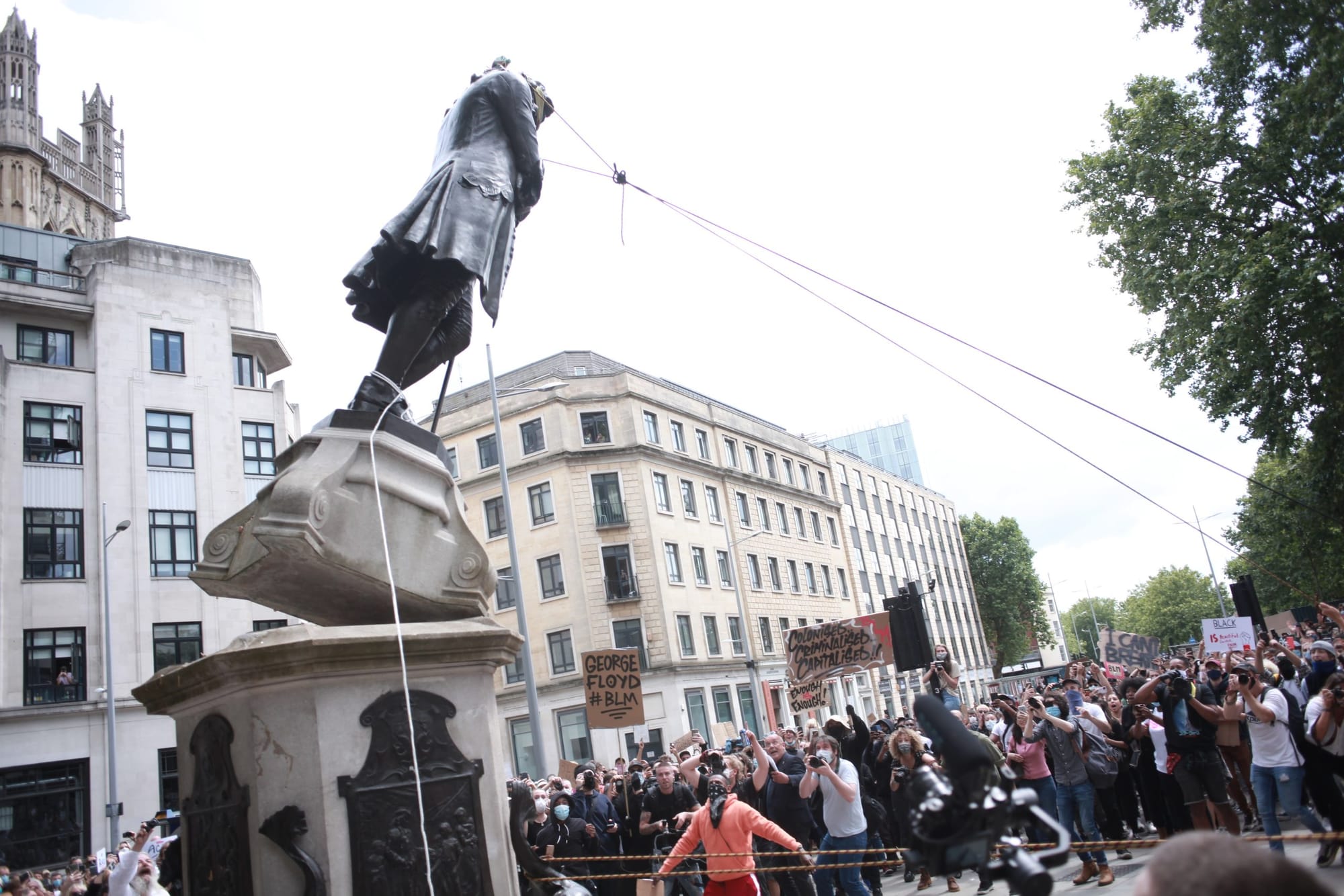
I am always suspicious of mass social hysteria in its many forms. From tribalistic vandalism when one's sports team loses to the election-time vitriol when one's political 'team' loses. These flavours of social hysteria are limited by national borders or locality; they are contained and they can be understood. Even in a world where the internet has collapsed geography, we are generally insulated from hysteria which is not homegrown. This is what makes Britain's latest American import, the Black Lives Matter (BLM) phenomenon, an oddity worthy of analysis.
In Britain, the last large-scale outpouring of this kind came after the 2016 vote to leave the EU. A well-publicised period of mourning, akin to that following to the death of Lady Diana Spencer, followed. Both the death of Diana and Brexit are events of national, constitutional importance to the British people. The magnitude of their impact in the UK can be easily understood with this in mind. To this day, one still sparks high levels of conspiratorial thought; the other is a tragic car accident. Four bitter years after the 2016 referendum, we are fortunate to have seen the back-end of Brexit early in 2020. Now, after three politically uneventful months of state-sanctioned boredom, the public is yearning for a successor to the electoral tribalism of Brexit. As a means to an end, George Floyd's death has provided precisely this opportunity.
It is amid the backlash to Brexit in 2016 that Black Lives Matter UK (BLMUK) first emerged in Britain. Its Facebook page was created a month after the referendum. In order to establish itself in Britain, BLMUK capitalised on the anti-Brexit sentiment of the moment. It also timed its debut to coincide with the fifth anniversary of the death of Mark Duggan, the catalyst of the 2011 London riots. To understand Britain’s more recent Black Lives Matter phenomenon and the dizzying heights of ideology surrounding it, I will examine three key factors, which together, I believe have brought about this perfect storm.
Political homelessness:
Firstly, in the Anglosphere, the political left has been floundering electorally, and badly. In Britain, if the Fixed Term Parliament Act of 2011 is abided by, the crushing defeat of Corbyn's Labour in December 2019 represents the last morsel of electoral pageantry for five years. After the most politically vigorous decade in recent history, this is a bitter shock to many. For the tech-literate, who have spent much of their young adulthood playing the role of political pundit on social media, it represents a catastrophic slump. Precisely where will this energy be directed if it's not to be funnelled down party lines any time soon?
BLM's cause appears inadequately political for those hungry for partisanship. The basic sanctity of black life and freedom to live that life without subjection to police abuse is not a political stance; it is a fundamental aspect of the British way of life, enshrined in Britain's codex of policing since Robert Peel invented the modern police. Luckily for those seeking political tribalism, BLM's motives in Britain are more intricate and far more political than stated here.
On July 6th, Glasgow's statue of the father of modern policing, Robert Peel, was vandalised to bear a red hammer and sickle. This seems an unusual move, considering BLM's aim is to ameliorate racism, though becomes clearer upon examining BLMUK's gofundme page, started on July 2nd. The movement describes itself as a "coalition of organisers" who are guided by a "commitment to dismantle imperialism, capitalism, white-supremacy, patriarchy and the state structures that disproportionately harm black people". As guiding principles, these aims are as radical as they are unattainable without political steps at the least, revolutionary ones at the worst. In Britain, as in the United States, protests concerning "state structures" and the dismantling of them are inherently political; the right to do this is neither universal nor fundamental. To the delight of those seeking an outlet for the political partisanship they so miss, BLMUK is a political organisation, but one which claims its cause is nobler than mere politics.
It is because of these overtly political aims that BLMUK is unable to register with the Charities Commission in Britain and have been relegated to gofundme. Amnesty International was denied charitable status on the same basis following a 1981 court ruling. In lieu of charitable trustees bound by fiduciary duties, any legal assurances as to where the million pounds raised by BLMUK will go are out of the question. The good news for BLMUK is that following the 2006 Charities Act "the advancement of human rights" was explicitly made a charitable purpose. The bad news is that this is contingent on that charities' work sufficiently being "for the public benefit". Worse still, the Charities Comission's guidance states that political activity "cannot be the continuing and sole activity of [a] charity". With a goal as radical as dismantling of capitalism, perpetual political activity seems a likely fate for BLMUK, especially if it continues to tap into the identity focussed, anti-establishment politics of the left to amass support in Britain.
Tapping into fringe activism is a proven strategy, and Extinction Rebellion (ER) is a success story in this regard. Packaging fringe, radical ideas alongside causes that are ordinarily cared about is nothing new when trying to broaden appeal. For ER, such ideas hide behind the veil of environmentalism, for BLMUK, anti-racism. Local councils and authorities in Britain have been sucked into endorsing the noble causes on the surface, witless to these radical undercurrents that come with them. By couching its aims in the language of radical political change, BLMUK is clearly leaning into those politically frustrated Momentum activists who have been left politically homeless by Post-Corbyn Labour.
A sterile internet:
The second leg of understanding this phenomenon is the maturity of the internet at this moment in time. In the passing decade, the internet has matured into a corporatized space, a process which is ongoing. Today, the 'Big Five' social media platforms are most accommodating to preestablished media outlets, journalists and the celebrity commentariat. Gary Lineker operating as a moral authority on current affairs has become the new online norm in 2020. Google's 2017 advertising policy changes neatly illustrate the net's shifting spotlight, away from the ordinary man and towards the establishment. Google's subsidiary, Youtube, dropped the tagline "broadcast yourself" and its policy changes swung so far in the direction of "brand safety" that independent media outlets saw their income drop to nothing overnight and their existence challenged.
Amid protests concerning something as unmentionable as race, personalities operating on the brand-safety conscious internet of 2020 can only draw one conclusion, "Black Lives Matter". The economic ramifications of appearing contrite are too great, and a deeper dive into the unfathomable ideological quagmire of modern activism is beyond the pay-grade of even the most adept marketing teams. A simple "we support you entirely" might seem like a naïve platitude, but is also an inexpensive alternative to an advertising campaign at a time when many brands and celebrity personalities are feeling the pinch of their new 'non-essential' status. What I am saying is, this is a vastly different digital landscape to that seen only 5 years ago and a place of nigh unrecognisable corporate sterility compared to only a decade ago.
Despite this, in 2019, 49% of British adults claimed social media was their primary source of news and commentary in Ofcom's news consumption study. This number would be higher, had Ofcom asked amid COVID-19. In April of 2020, web optimiser Fastly reported that internet use in the United Kingdom increased by a staggering 78.6% since lockdown measures were introduced. From available data, this is the second-highest percentage increase worldwide. Social media is more punctuated by news media and moralising calls to arms than ever, at the same time, it has becomes many people's primary means of socialising during lockdown. As we become a nation of permanent stay-at-homes, it is easy to see how the social hysteria surrounding BLM has been imported from the United States in a magnitude it would otherwise not have been.
State-Sanctioned Boredom:
The third leg is simple, boredom. As lockdown measures continue, this boredom increasingly manifests as frustration and anger toward the state, and justifiably so. The approach to the pandemic in the Anglosphere has been authoritarian, at least by British standards. When activists like BLM co-founder Opal Tometi speak of "fundamental rights" being at stake, they are right, in a certain sense. Several rights contained in the European Convention on Human Rights (ECHR) and legally enshrined in the British Human Rights Act 1998 have been qualified during lockdown. Among them, the rights to a fair trial, to manifest one's religion and even the right to liberty itself, controversially allowed for in Article 5(1)(e). As far as the ECHR is concerned, none of the above are considered "absolute" rights and can, therefore, be limited in a manner proportional to threats arising to public safety, health and of criminal disorder – all things we face today. The effect of this is not that there are less things to do, but that there are less things one is allowed to do.
Articles 10 and 11, the rights to peaceful protest and freedom of expression respectively, are no exception, and can be qualified too. With shops, places of worship and courthouses closed, these are also the easiest ECHR rights to exercise. Regulation 7 of the amended Health Protection (Coronavirus Restrictions) (England) Regulations 2020 goes further than the ECHR qualifications, criminalising gatherings of 7 people on June 1st. Given that the social distancing measures are merely guidelines, even protests spaced at 2 metres constitute illegal gatherings if made up of more than half a dozen people, but they are, at least, something to do.
Conclusion:
Without a doubt, identifiable fundamental rights in Britain are at stake here, and for many engaging with protests across Britain these stakes might factor into their defiant presence on the streets. We have every right to be bored with our world closed and our minds yearning, but as of July 2020, there exists no fundamental human right to criminally damage public monuments in the ECHR. These are collective crimes of boredom, a symptom of a long, illiberal and state-sanctioned malaise, the likes of which modern Britain has never seen The pulling down of such figures serves as wish fulfilment for those politically defeated and sensorially deprived by lockdown.
The felling of figures like that of Edward Colston and the eagerness of certain public officials to navel-gaze over who will be next shows a concerning lack of backbone and is tantamount to admitting guilt. Public sculpture may indeed instil a sense of alienation in black Britons, but I see no metric to support this. Now that people have heard of Colston, opinion remains divided on the issue if YouGov’s July 8th poll is anything to go by. If pressed on the matter, I sincerely doubt that even those who support the removal of public sculpture would argue that iconoclasm, of a plainly illegal kind, is the solution to this as-yet unmeasured metric. To my mind, those who presume to speak (and ac)t on the behalf of alienated individuals have made a grave miscalculation. In lieu of any actual victory, activists are consigned to seek symbolic victories that reductively erode the material culture of Britain and antagonise those who love this country.
In a liberal democracy where we are accustomed to speaking our minds and going about our business as we please, this is a predictable response to the measures we have been burdened with this year. Much as Brexit was considered an anti-establishment "revolution" for middle England, recent events in Britain represent a similar outpouring of the voiceless. Unlike Brexit, the politics of identity (espoused by BLMUK) have already been trialed in a democratic context and decisively rejected by the electorate – that is why it is so revolutionary in tone. The events unfolding in Britain have almost nothing to do with George Floyd's death. Instead, the trifactor of a politically homeless radical left, a mature internet and a bored, politically restless populace has created the perfect storm – if Britain is to resist succumbing to mob rule, this is a storm which must be hardily weathered